Table of Contents

Win more bids. Close more jobs. Start with our newsletter.
Get exclusive insights, tips, and trends your competition doesn't want you to know.

Key takeaways
- The U.S. roofer median wage is $24.05 per hour, or $50,030 a year, according to the latest Bureau of Labor Statistics data, with the top 10 percent earning $79,850 or more.
- Pay varies more by state than most trades. Top-paying states like Massachusetts, Illinois, Connecticut, and California pay roofers around $69,000 to $72,000 annually on average, while Texas and Florida average closer to $44,000 to $47,000.
- Commercial roofing typically pays more than residential because of system complexity, equipment, safety requirements, and union presence on larger jobs.
- Six figures is realistic for foremen, commercial leads, salespeople, and storm-chaser crews working overtime. Most roofers reach it through a combination of role and hours, not by hourly wage alone.
- Pay structure matters as much as wage rate. Hourly, piece rate, day rate, and bonus mixes each create different incentives for production, quality, and retention.
- For roofing contractors, JobNimbus turns job-cost data into pay-decision data, so wage increases line up with the margin to support them.
Roofer salary is one of the most-searched questions in the trade, and most of the answers online are noise. Job boards quote ranges that lump apprentices in with foremen. Marketing posts cherry-pick the high end. AI overviews pull averages from data that's two cycles old. The actual numbers, from the U.S. Bureau of Labor Statistics, are public and current, and they tell a more useful story than any of the secondary sources.
This guide walks through what roofers actually earn in 2026, broken down by experience level, region, residential versus commercial, and union status. It covers the realistic paths to $100K, the pay structures contractors use, and the data points owners need when setting wage bands. Whether the goal is benchmarking your own pay or building a compensation ladder for a growing crew, the numbers here come from BLS, not from a job-posting algorithm.
What roofers actually earn in 2026
The cleanest national number for roofer pay is the BLS Occupational Employment and Wage Statistics (OEWS) survey, which polls employers directly. The most recent OEWS release puts the U.S. roofer mean hourly wage at $26.85 and the median at $24.05 per hour, or $50,030 annually based on a 2,080-hour year.
Percentile data shows the spread:

A few things to read from this table. First, the gap between the 25th and 75th percentile is about $18,000 annually, which is wider than most construction trades. That spread reflects the difference between a first-year laborer and a journeyman foreman on a commercial crew, plus regional variation. Second, the 90th percentile crosses $79,000, meaning the top tier of roofers without owning a business already approach six figures before factoring in overtime and bonuses.
Why "average roofer salary" answers vary so much
Job boards like ZipRecruiter and Indeed report numbers based on posted listings, which skew higher than employer-reported survey data because higher-paying listings get more attention. AI overviews and aggregator sites often quote two- or three-year-old data without flagging it. BLS OEWS is the cleaner source for benchmarking because it surveys employers directly and updates annually.
For owners, the practical takeaway is to use BLS percentiles as the floor signal and adjust upward for local market conditions. Storm-chaser markets (parts of Texas, Oklahoma, Colorado, Florida) frequently pay above the local median during active hail and wind seasons. Tracking actual job-cost data through a tool like profit tracker is what tells an owner whether the margin supports paying above local average or not.
Roofer salary by experience level
Pay scales tightly to role. The same ZIP code can produce a $19/hour first-year laborer and a $40/hour foreman, and the difference comes down to what each one brings to the crew.
Apprentice and entry-level
Apprentice roofers typically start in the $17 to $20 per hour range, lining up with the BLS 10th to 25th percentile. The work is "show up, learn, prove you can carry weight." Skills that accelerate raises are tear-off speed, basic detail work (drip edge, valleys, pipe boots), and consistent reliability. Union apprenticeships pay on a published progression schedule that ties wage increases to documented hours and classroom hours.
Journeyman
A journeyman roofer who can run a section of roof unsupervised, install valleys and flashing correctly, and read a manufacturer spec earns toward the median to 75th percentile, roughly $24 to $30 per hour in most U.S. markets. Manufacturer training certifications (GAF Master Elite, Owens Corning Platinum, CertainTeed SELECT, etc.) sometimes carry a small wage premium and can be a faster path to a raise than tenure alone.
Lead, foreman, and superintendent
Lead roofers and foremen run a crew, sequence the work, and are accountable for quality and callbacks. Pay typically lands in the $30 to $40 per hour range, with the high end of the BLS distribution ($38.39 at the 90th percentile) representing this tier. Superintendents managing multiple crews on commercial work often earn above $80,000 annually with truck and bonus components.
Estimator and project manager
The off-roof career path. Roofing estimators and project managers typically move to salary-plus-bonus structures. Estimator base pay commonly runs $55,000 to $80,000 with commission or bonus tied to closed work. Project managers in commercial roofing often clear $80,000 to $110,000 base depending on volume and region. Building accurate, fast bids matters here, which is why the estimates workflow gets used heavily by shops promoting field roofers into estimating roles.
Commercial roofer salary vs. residential roofing pay
Commercial roofing typically pays more than residential, and the BLS industry data confirms it. Roofers working in nonresidential building construction earn an annual mean of $64,670, compared to $58,460 in residential building construction and $55,580 in foundation, structure, and building exterior contractors (the residential-heavy category). Building finishing contractors, which includes some commercial finishing work, top the list at $66,580.
The reasons for the gap:
- Commercial systems (TPO, PVC, EPDM, modified bitumen, BUR) require more training and certification than asphalt shingles.
- Commercial jobs more often involve lifts, cranes, and rooftop equipment, which raises the skill premium.
- OSHA scrutiny and fall-protection requirements are stricter on commercial sites with longer schedules.
- Union density is higher in commercial work, which raises wage floors even for nonunion competitors in the same metro.
Within residential, shingle crews working piece rate can earn well in busy seasons but absorb the downside of weather, callbacks, and short jobs. Within commercial, service technicians who diagnose leaks and handle repair calls often earn more than new-construction installers because the work requires more troubleshooting and customer interaction. Specialty niches, including waterproofing, air barriers, green roofs, and solar-ready roofs, command additional premiums.
For contractors weighing how pay rates affect bid pricing, the relationship between crew cost and quoted price is covered in our walk-through of how to price a roofing job.
Union roofer salary and total compensation
Union roofer pay is best understood as a total compensation package, not just an hourly wage. The base wage looks lower than some claim because the package includes:
- Hourly base wage (the "scale")
- Health and welfare contribution (employer-paid)
- Pension and annuity contribution (employer-paid)
- Apprenticeship and training fund contribution
- Paid time off and holiday provisions in some locals
A union local in a major metro might publish a journeyman scale of $42 per hour and an effective package value of $65 to $75 per hour once benefits are counted. Comparing nonunion wages directly to union scale without accounting for the benefit value is a common mistake on both sides of the negotiation.
Prevailing wage on public work
Federal contracts above $2,000 are governed by the Davis-Bacon Act, which requires contractors to pay locally prevailing wages and benefits to laborers and mechanics, including roofers. Davis-Bacon wage determinations published by the U.S. Department of Labor function as a floor for public-sector roofing work and often exceed local nonunion private-market rates by a wide margin. State-level "little Davis-Bacon" laws apply similar rules to state-funded work in many states.
Union apprenticeship
Union apprenticeship programs typically span three to four years with structured wage progression tied to hours worked and classroom completion. Candidates evaluating a union local should ask about the published scale, when benefits start (some locals require accumulated hours before health coverage kicks in), tool requirements, and travel obligations. The trade-off for the structured progression is geographic constraints and dispatch realities that don't suit every roofer.
Roofer salary by state
State-level pay varies widely, and the cost-of-living math doesn't always cancel out the wage difference. The table below uses BLS state-level OEWS data for the highest-employment and highest-paying states.
A few observations from the data:
- Massachusetts pays the highest mean wage in the U.S. at $72,390 annually, driven partly by union density and metro Boston cost-of-labor pressure.
- Florida employs the most roofers of any state at over 25,000, but the mean wage of $47,030 reflects a heavily residential, hurricane-driven market with year-round work and high competition.
- Chicago metro at $73,280 annual mean edges out the Illinois statewide figure, showing how metro concentrations shift the picture.
- Texas at $21.39 hourly mean sits below the national median, even with steady storm work. The market scale and competitive residential pricing keep wages compressed relative to coastal states.
For Colorado specifically, the Northwest Colorado nonmetropolitan area shows a $25.30 hourly mean ($52,610 annual), reflecting the hail-driven commercial reality of Front Range markets. Statewide Colorado data sits in a similar range. Roofers working hail seasons can pull pay well above the mean during peak weeks through overtime and storm response.
How roofers reach $100K a year
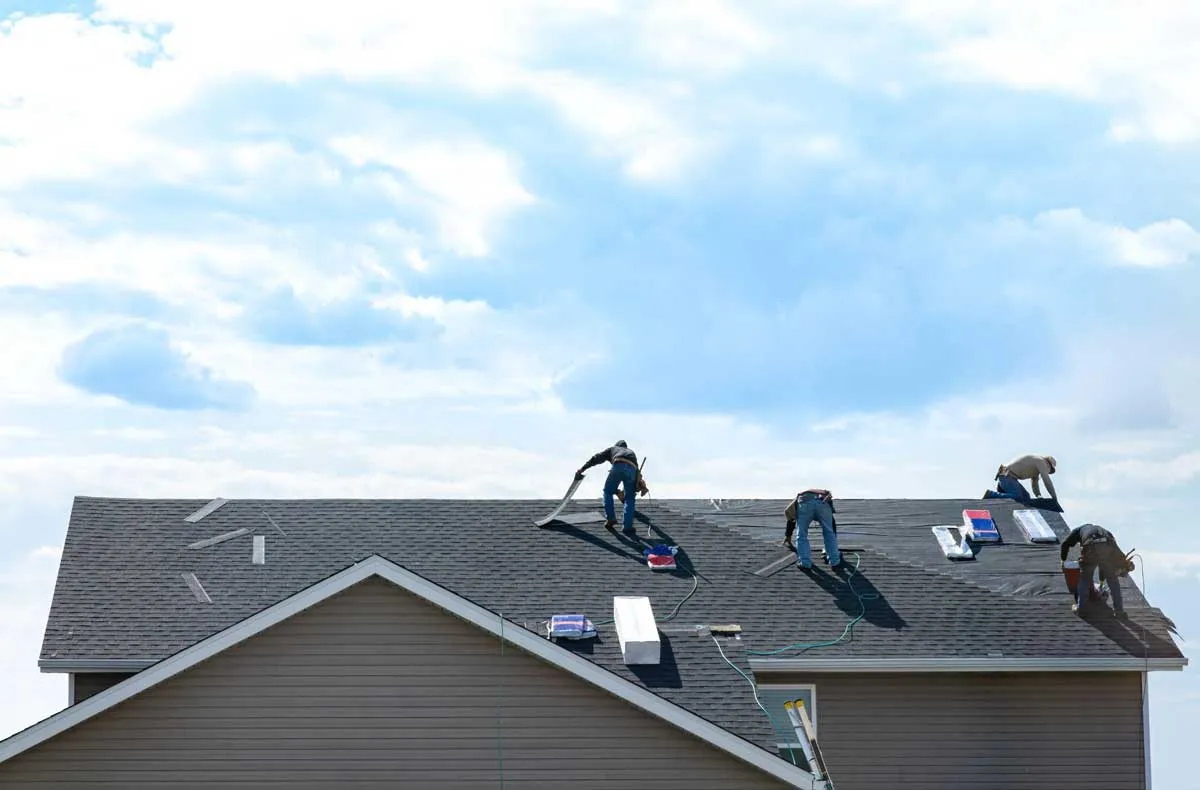
Six figures in roofing is realistic, but it almost always requires a combination of factors rather than hourly wage alone. There are four practical paths.
Hours plus rate
The straightforward path. A roofer earning $35 per hour with consistent 50-hour weeks during a busy season can clear $100K. Storm response markets (parts of Texas, Florida, Oklahoma, Colorado) compress hours into peak weeks where 60 to 70 hours becomes routine. The downside is real: burnout, injury risk, and the seasonal feast-or-famine rhythm. Owners watching crews push hard during peak should plan for retention investments, since the next storm market over is recruiting them.
Move up
Foreman, superintendent, safety lead, and quality control lead roles all break $100K with reasonable consistency in mid-to-large markets. The qualifications are predictable: production reliability, low callback rate, ability to train others, and willingness to handle the paperwork side. Owners reward production predictability more than raw speed, and that distinction often surprises field roofers stepping into leadership for the first time.
Move sideways
Estimating, project management, and roofing sales all open six-figure doors without owning the business. Roofing salespeople on commission structures can earn well into six figures in storm and insurance markets. Sales discipline is the bottleneck: closing ratios, lead management, and follow-up. The path is laid out in detail in our walk-through of how to make millions in roofing sales.
Go independent
Owning a small roofing operation can produce six-figure owner income, but revenue is not income. A solo or two-person operation grossing $400,000 in revenue might net the owner $90,000 to $130,000 after materials, labor, equipment, insurance, marketing, taxes, and overhead. Pricing discipline is the difference between a profitable shop and a busy bankruptcy. The independent path also adds risk: cash flow gaps, slow-paying customers, and the administrative load of running a business.
Roofer pay structures: hourly, piece rate, day rate, and bonuses
How roofers get paid affects production, quality, and retention as much as the dollar amount. Most established shops use one of four structures or a hybrid.
Hourly is the default and the most common. It rewards consistency and is easy to administer but doesn't directly incentivize speed. Hourly pay works best for crews doing complex work, commercial systems, or service calls where quality and customer interaction matter more than square count.
Piece rate (per square installed) is common for residential shingle crews. It rewards speed and can produce strong income for fast crews in busy seasons. The downsides are real: quality issues when crews rush, weather and complex roofs that crush per-square earnings, and the disputes that surface when the scope of "one square" gets fuzzy on cut-up roofs.
Day rate pays a flat amount per workday regardless of hours. It works for stable, experienced crews on predictable jobs but creates problems on long days and when weather shortens shifts.
Bonuses stack on top of the base structure: production bonuses tied to monthly square count, safety bonuses for incident-free quarters, zero-callback bonuses, and crew-lead profit shares are all common. Bonuses align crew behavior with shop profitability when designed well.
Total compensation should also include benefits, training pay, travel pay, tool stipends, certification reimbursement, and per diem for out-of-town work. These items improve recruiting in tight labor markets and often matter more to candidates with families than a couple of dollars on the hourly rate.
For owners, the operational side of pay structure is also a cash-flow question. Crews who get paid quickly stay longer, and shops with clean invoicing and fast collections can run leaner. Tools like JobNimbus's payments feature speed up the cycle from job-completion to deposit, which directly affects how soon crews see their cut. The retention math behind this is real: our look at why happy roofing crews outperform covers the link between crew satisfaction and shop profitability.
Pay your crew what the data supports
Roofer pay in 2026 is a moving target shaped by region, role, system type, and shop economics. The BLS data gives a defensible floor. Local market conditions move the ceiling. The contractors who pay competitively and retain crews are the ones who track job costs, know their margins, and tie wage decisions to actual profit data instead of guesswork.
JobNimbus brings job costing, profit tracking, estimates, and payments into one place built for roofing contractors. See how it helps you pay crews what the data supports at jobnimbus.com.

Frequently Asked Questions
The U.S. roofer mean annual wage is $55,840 according to the latest BLS Occupational Employment and Wage Statistics data, with a median of $50,030. The 90th percentile earns $79,850 or more.
Massachusetts pays roofers the highest mean wage at $72,390 annually, followed by Illinois ($70,110), Connecticut ($69,170), and California ($69,000), based on BLS state-level OEWS data.
Union roofers typically earn higher total compensation when health, welfare, pension, and training contributions are counted, even when the base hourly wage looks comparable to nonunion. Davis-Bacon prevailing wages on federal contracts further raise the floor on public work.
Yes, through a combination of overtime in busy seasons, foreman or superintendent roles, sales or project management positions, or owning a small operation. Six figures from base hourly wage alone is rare outside the highest-paying metros and the 90th percentile of the trade.
Field roofers use practical math: pitch, squares, waste factors, flashing takeoffs, and basic geometry for cuts and angles. Estimators handle more complex calculations including production rates, material lists by component, and labor budgets. The math is learnable and is a primary reason roofers move up: the trade rewards crews who can run the numbers as well as run the work.

Blog / Guide Title CTA
Once you've created a strong Linkedin profile, you can leverage it as part of your broader marketing strategy. Use your Linkedin to share content, join industry groups, and network with others in the contracting space.
If you're looking for additional marketing support, consider partnering with JobNimbus Marketing to maximize your business growth. Schedule a call with our team to learn how to boost your marketing efforts today.
Blog / Guide Title CTA
Once you've created a strong Linkedin profile, you can leverage it as part of your broader marketing strategy. Use your Linkedin to share content, join industry groups, and network with others in the contracting space.
If you're looking for additional marketing support, consider partnering with JobNimbus Marketing to maximize your business growth. Schedule a call with our team to learn how to boost your marketing efforts today.
Download Our Free Tips for Recession-Proofing Your Company
We’ll show you five simple things you can do to help your business survive a recession.