Table of Contents

Win more bids. Close more jobs. Start with our newsletter.
Get exclusive insights, tips, and trends your competition doesn't want you to know.

Updated on August 18, 2026
Key takeaways
- Pricing a roofing job accurately is more than counting shingles. It demands a full read on complexity, labor, overhead, and the profit margin you actually want to keep.
- Measurement accuracy sets the ceiling for every estimate. Manual math and rough square counts quietly leak profit on every bid.
- Overhead is where most contractors lose money. Rent, insurance, vehicles, and marketing have to be priced in, not prayed away.
- Markup and profit margin are not the same number. Treating them like they are is a classic way to underbid a roof.
- A clear, homeowner-friendly estimate closes more jobs than the cheapest quote on the street.
- Roofing software like JobNimbus pulls measurements, supplier pricing, labor, and overhead into one estimate, so contractors can quote faster and actually protect the margin.
Why roofing jobs lose money before the crew arrives
A roof that looks profitable on the back of a napkin can turn into a break-even nightmare the minute a waste factor gets missed or overhead goes unaccounted for. Underbidding is one of the most common ways roofing contractors quietly shrink their own margins. Industry data published by the National Roofing Contractors Association (NRCA) shows the average net profit margin for roofing contractors hovering around 6 percent in recent years, with many smaller shops still landing well below that. Translation: most companies have very little cushion when a job goes sideways.
Pricing a roofing job well is not about speed alone. It is about understanding the full scope: roof complexity, labor burden, disposal, overhead allocation, and the target margin you want to hit. Speed only matters when the number you give the homeowner is also accurate.
This guide walks through the five steps that turn a rough guess into a defensible, profitable roofing estimate, plus the tools that help contractors get there without burning an afternoon per bid.
1. Start with the homeowner conversation
Before you price the roof, make sure you know what you're pricing. Talk with the homeowner about why they called, what they want from the project, and anything that could affect the scope.
Ask about known leaks or previous repairs. Find out whether insurance is involved, what roofing materials they're considering, and whether they have a particular timeline in mind. Solar panels, skylights, satellite dishes, and other roof features can also affect the work.
This conversation is also your chance to learn what matters to them. One homeowner may care most about staying within budget, while another is willing to invest more in storm resistance, appearance, or warranty coverage. Those priorities can help you recommend the right options when you present the estimate later.
2. Inspect the roof thoroughly
The homeowner can tell you what they've noticed, but you still need to see what you're working with.
Look for anything that could affect materials, labor, scheduling, or scope (including steep pitches, valleys, dormers, multiple layers, damaged decking, flashing problems, ventilation issues, and difficult access). Take clear photos of what you find, especially when an issue will affect the work you're recommending.
Those photos can become useful again when you present the estimate. Instead of asking a homeowner to take your word for it, you can show them the damage behind the line item.
3. Get accurate roof measurements
Small measurement mistakes can become expensive pricing mistakes. Measure the roof carefully and account for its actual surface area, pitch, complexity, and waste.
One roofing square equals 100 square feet of roof surface, but square count doesn't tell the whole story. A simple gable and a cut-up roof with several hips, valleys, and dormers can have similar square footage and require very different amounts of material and labor.
Whether you measure manually or use an aerial measurement tool, verify your numbers before you start calculating costs. If you need a refresher on the math, see our guide to calculating roofing squares.
4. Calculate your true costs: materials, labor, and overhead
True cost is the number you need before markup even enters the conversation. It breaks into three buckets, and every one of them has to be priced honestly.
Materials
Material costs fluctuate with the market, so always pull current pricing from your supplier rather than relying on last year's numbers. The per-square cost of shingles is the anchor, but the extras stack up fast: underlayment, ice and water shield, drip edge, flashing, ridge cap, nails, pipe boots, and ventilation. On a typical residential reroof, those extras can add several hundred to over a thousand dollars before labor is counted.
Labor
Labor cost is where burden bites. The raw hourly wage is only part of the math. According to the U.S. Bureau of Labor Statistics, the median annual wage for roofers was $50,970 in May 2024, which works out to roughly $24.50 per hour. On top of that wage, labor burden (payroll taxes, workers' compensation, general liability, and benefits) typically adds 20 to 35 percent, pushing the true cost of a $24.50 per hour roofer closer to $30 to $33.
Multiply that fully burdened rate by crew size and estimated hours. A two-person crew running 30 hours on a straightforward reroof is roughly 60 labor hours. Steep pitches, tear-offs of multiple layers, and complex rooflines add hours fast.
Overhead
Overhead is the quiet killer. Rent, vehicles, fuel, insurance, software subscriptions, marketing, office staff, and the owner's salary all have to be covered by the jobs you bid. Ignoring overhead is how contractors end up thinking they are profitable until tax time tells a different story.
The cleanest way to bake in overhead is to calculate a per-hour overhead rate. Take your total monthly overhead, divide it by monthly labor hours, and apply that rate to every bid.
The formula that keeps bids honest:
Total job cost = direct materials + direct labor + allocated overhead
Markup goes on top of that number, not in place of it.
Well-run roofing companies generally target gross margins of 25 to 40 percent and net margins of 8 to 15 percent, depending on job mix, efficiency, and regional market. Anything materially below that range is a signal to look at either pricing discipline or overhead drag.
5. Add your markup and set a profitable price
This is where markup and profit margin get confused, and where a lot of money gets left on the table. They are not the same thing.
Markup is the percentage added to total cost to set the sales price. Markup = (price - cost) ÷ cost.
Margin is the percentage of the sales price that is profit. Margin = (price - cost) ÷ price.
A 30 percent markup is only a 23 percent gross margin. A 50 percent markup is a 33 percent margin. Contractors who price off markup without checking the resulting margin routinely underbid.
Realistic markups in today's market vary by job type and region. Standard reroofs often run 25 to 40 percent markup. Service and repair work can go higher because the overhead allocation per dollar is heavier.
One practical warning: do not itemize overhead on the customer-facing quote. Fold it into your labor and material line items. Homeowners do not want to feel like they are paying for your office rent, even though they always are.
Quick-reference roofing pricing math
Pro tips for a roofing estimate homeowners actually understand
The most profitable bid is useless if the homeowner cannot read it. Clean, homeowner-friendly estimates close at higher rates and trigger fewer "can you come down?" calls.
A strong roofing estimate includes:
- Project timeline and start window
- Itemized materials (brand, color, warranty)
- Scope of work, including tear-off, decking repair, and cleanup
- Permit and inspection costs
- Labor and crew details
- Payment terms and schedule
- License and insurance information (if you are still working through this, the roofing contractor license requirements vary widely by state)
- Manufacturer and workmanship warranties
A few tactics that consistently lift close rates:
- Offer good, better, best options. Giving homeowners tiers instead of a take-it-or-leave-it number moves the decision from "yes or no" to "which one."
- Personalize the bid. Reference the inspection photos, the homeowner's concerns, and the specific features of their roof.
- Move fast. Same-day or next-day delivery of an estimate beats a polished version that arrives a week later. Speed is a credibility signal.
- Walk them through it. A 10-minute call or in-person review of the estimate beats any PDF sitting in an inbox.
- Follow up without pressure. One thoughtful check-in at three days and again at seven days is usually enough.
Contractors who want to sharpen the craft behind every bid can dig into the habits of top contractors that separate consistent earners from the rest of the field.
How roofing software makes accurate estimating faster
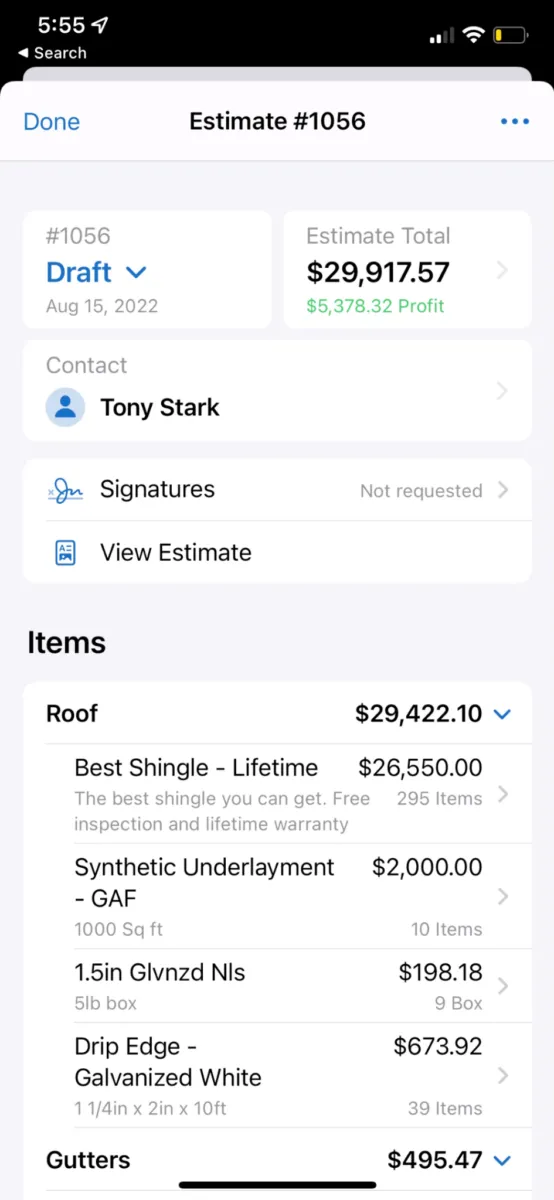
Manual estimating is slow, and slow estimates lose jobs. A bid that takes 20 minutes of math on a kitchen table is a bid the homeowner has already gotten two competing quotes for. Roofing software flips that equation.
JobNimbus gives roofing contractors a single place to price, present, and protect every bid:
- Smart estimating with live supplier pricing. Integrations with major distributors pull current material costs straight into the estimate, so a sudden shingle price hike does not silently eat the margin.
- Mobile-first workflow. Estimates can be built, adjusted, and sent from the driveway, not hours later from the office.
- Professional proposals with e-signature. Good, better, best options, photos, warranties, and payment terms sit in one homeowner-ready document that can be signed on a phone.
- Measurement integrations. EagleView and Hover numbers pull directly into the estimate, skipping the ladder math.
- Workflow automation and job costing. Actual costs are tracked against the estimate in real time, so margin erosion shows up before the job wraps, not a month after.
- QuickBooks sync. Invoicing, payments, and financials stay aligned without manual re-entry.
The bigger win is consistency. Every estimator on the team builds bids the same way, with the same pricing logic, and the numbers hold up when the homeowner asks questions. Less paperwork, more roofing, and the profit actually showing up where it is supposed to.
Newer contractors building their first repeatable workflow can get a wider lay of the land in this guide for roofers starting out, which pairs well with the pricing fundamentals here.
Make every roofing bid count
A good roofing estimate is not a guess. It is the output of a repeatable process: homeowner conversation, thorough inspection, accurate measurements, true cost calculation, and disciplined markup. Run that process every time and the bids stop surprising you, in either direction.
The contractors who grow in a tough market are the ones who know their numbers, price with confidence, and present estimates homeowners can actually understand. Speed matters, but only on top of accuracy.
Ready to make estimating faster, tighter, and more profitable? See how JobNimbus helps roofing contractors build winning bids in minutes, not hours.

Frequently Asked Questions
Pricing a roofing job is the process of calculating what a roof will truly cost to install or replace (materials, labor, and overhead) and adding a disciplined markup to set a sales price the homeowner will accept.
A roofing estimate is a written quote that outlines scope, materials, labor, timeline, and total price for a roofing project.
A square is the standard unit of measurement in roofing. One square equals 100 square feet of roof surface area.
Labor burden is the additional cost on top of base wages: payroll taxes, workers' compensation, general liability, and benefits. It typically adds 20 to 35 percent to a roofer's hourly rate.
Markup is added to the cost to get the price. Margin is the percentage of price that is profit. A 30 percent markup produces a 23 percent gross margin, not 30 percent, so confusing the two leads to consistent underbidding.
Yes. Modern roofing CRMs pull measurements from aerial providers, apply current supplier pricing, calculate labor and overhead, and generate homeowner-ready proposals in minutes instead of hours.
Speed, clarity, personalization, and credibility. Fast delivery, a clean itemized scope, reference to the specific home, and visible insurance, licensing, and warranty details all move close rates up.
Also, good, better, best estimates give homeowners a choice of tiers, which consistently closes at a higher rate than single-option bids and often nudges buyers toward a higher-value package.
Well-run roofing companies typically target 25 to 40 percent gross margin and 8 to 15 percent net margin. Net margins below that range usually point to a pricing or overhead problem rather than a sales problem.
Start by understanding the scope and getting accurate roof measurements. Calculate the full cost of materials, labor, waste, overhead, and other job expenses, then add enough markup to reach the profit margin your company needs. Your final price should cover the true cost of performing the work while leaving room for profit.
A roofing estimate should account for materials, labor, waste, disposal, overhead, permits or fees where applicable, and any other costs required to complete the scope. The customer-facing estimate should clearly explain the work, materials, timeline, payment terms, and warranties so the homeowner understands what the price includes.
Markup measures how much you add to your cost when setting the selling price, while profit margin measures how much of the selling price remains as profit after costs are deducted. For example, adding a 30% markup to a $10,000 cost results in a $13,000 selling price and approximately a 23% gross margin.
Not automatically. Other roofing companies may have different labor costs, materials, overhead, scopes, or profit goals. Competitor pricing can provide useful market context, but your estimate should ultimately reflect what the job costs your company and the margin you need to earn.
Competitive roofing bids combine accurate pricing with clear value. Explain the scope, materials, warranties, and other details behind your price; use inspection photos when helpful; offer relevant options; deliver the estimate promptly; and walk the homeowner through the proposal so they can make an informed comparison.
Financing can give eligible homeowners another way to pay for a roofing project when the lump-sum price is difficult to manage. If you offer financing, present the available options clearly alongside the estimate and explain the applicable terms and costs so the homeowner can decide if financing makes sense for them.

Blog / Guide Title CTA
Once you've created a strong Linkedin profile, you can leverage it as part of your broader marketing strategy. Use your Linkedin to share content, join industry groups, and network with others in the contracting space.
If you're looking for additional marketing support, consider partnering with JobNimbus Marketing to maximize your business growth. Schedule a call with our team to learn how to boost your marketing efforts today.
Blog / Guide Title CTA
Once you've created a strong Linkedin profile, you can leverage it as part of your broader marketing strategy. Use your Linkedin to share content, join industry groups, and network with others in the contracting space.
If you're looking for additional marketing support, consider partnering with JobNimbus Marketing to maximize your business growth. Schedule a call with our team to learn how to boost your marketing efforts today.
Download Our Free Tips for Recession-Proofing Your Company
We’ll show you five simple things you can do to help your business survive a recession.