

Table of Contents

Win more bids. Close more jobs. Start with our newsletter.
Get exclusive insights, tips, and trends your competition doesn't want you to know.

Key takeaways
- Solar photovoltaic (PV) installers turn sunlight into electricity by mounting panels, wiring inverters, and commissioning systems on residential and commercial buildings.
- A four-year degree isn't required. A high school diploma, trade school or apprenticeship training, OSHA 10 safety certification, and hands-on field experience are the standard entry points.
- NABCEP certification is the industry's gold standard. It isn't legally required everywhere, but it boosts hireability, salary ceiling, and customer trust on every install.
- Demand is exploding. The U.S. Bureau of Labor Statistics projects 42% job growth for solar PV installers from 2024 to 2034, making it one of the fastest-growing occupations in the country.
- Career growth is real and reachable. Experienced installers move into crew leadership, project management, or start their own solar businesses, where tools like JobNimbus keep operations organized from first lead to final inspection.
What does a solar installer do?
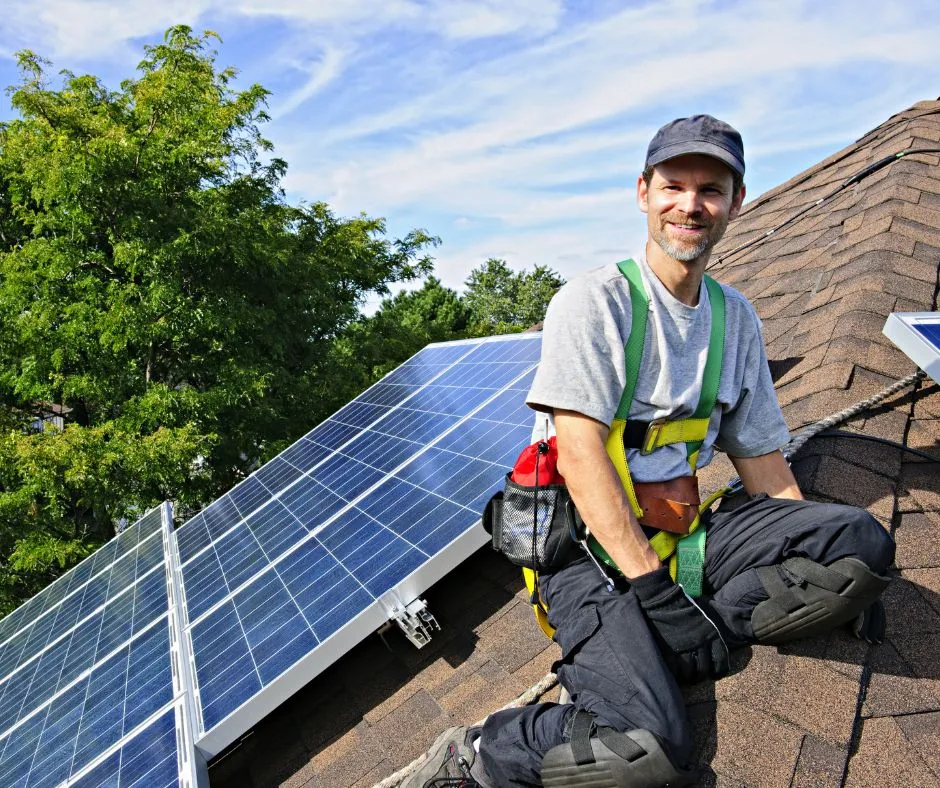
A solar installer, officially called a solar photovoltaic (PV) installer, assembles, mounts, wires, and maintains the systems that turn sunlight into usable electricity. It's physical, outdoor work that blends construction, electrical skills, and customer-facing problem solving.
But the job isn't just about bolting panels to a roof. Today's installers advise homeowners on system sizing, evaluate structural conditions, troubleshoot inverter issues, and make sure every installation meets local code and manufacturer specs. The best ones become trusted experts who clients lean on for years.
Job responsibilities
A typical day on a residential install might include:
- Conducting site assessments to evaluate roof condition, shading, and structural integrity
- Installing mounting hardware, racking, and weatherproofing (flashing, sealants, and membranes)
- Assembling solar modules and connecting them to inverters and the electrical grid
- Performing minor electrical work, such as running conduit, wiring junction boxes, and verifying grounding
- Testing completed systems to confirm voltage, output, and safety
- Maintaining and troubleshooting existing arrays
- Advising homeowners on performance monitoring, cleaning, and long-term care
Skills required
Solar installation rewards a specific mix of technical know-how and physical grit. Expect to need:
- Working knowledge of solar panels, inverters, batteries, and grid-interconnection basics
- Comfort working at heights and in all weather conditions
- Physical stamina for lifting heavy materials (panels typically weigh 40 to 50 pounds each)
- Strong problem-solving skills for on-site troubleshooting
- Teamwork and clear communication with crew members and customers
- Basic math and measurement skills for layout and wiring calculations
Prior experience in roofing, electrical work, or general construction is a major head start. If you've already pulled a roofing contractor license or worked under one, you're farther along than most career-changers walking onto a solar crew for the first time.
Types of solar panels every installer should know
The solar panel types dominating today's market are monocrystalline, TOPCon, bifacial, PERC, and thin-film. Customers expect their installer to know which one fits their home, budget, and climate, and to explain the trade-offs without resorting to spec-sheet jargon.
Here's what each technology brings to the table:
- Monocrystalline (mono): The workhorse of residential solar. High efficiency (22% and climbing), long lifespans, and compatibility with nearly every roof type. Most mono panels now use PERC, TOPCon, or HJT cell architectures.
- TOPCon (N-type): Rising fast as the next-generation standard. Better efficiency and lower degradation than traditional PERC, with strong performance in high-temperature conditions.
- Bifacial panels: Capture sunlight from both the front and the rear, boosting energy yield, especially on ground-mount and flat commercial roofs. Popular for utility-scale and increasingly common in residential areas.
- PERC (Passivated Emitter Rear Cell): Still widely installed, though manufacturers are shifting toward TOPCon and HJT for higher efficiency.
- Thin-film and emerging tech: A niche category including amorphous silicon and newer perovskite concepts. Used in specialty applications like BIPV (building-integrated photovoltaics) and portable solar.
Understanding where each technology shines (pun intended) helps you pair the right panel with the right job, which translates to happier customers and stronger reviews.
Training and qualification paths: how to get started
The path into solar installation is flexible, which is good news if you're switching careers or starting out. Here are the most common entry routes:
- High school diploma or GED: The baseline requirement for nearly every solar employer.
- Trade school or community college programs: Many offer solar-specific certificates that cover electrical fundamentals, PV system design, and safety.
- Apprenticeships: Registered apprenticeships combine paid on-the-job training with classroom instruction. The 2022 Inflation Reduction Act tied registered apprenticeship requirements to clean energy tax credits, which has expanded the number of solar apprenticeship programs nationwide.
- On-the-job training: Many employers hire entry-level helpers and train them over 6 to 12 months. This is the fastest way to start earning while learning.
- OSHA 10 (Construction): A 10-hour safety course that nearly every employer and certification body expects. Inexpensive, online, and a no-brainer first step.
Prior experience in related trades makes a noticeable difference. Electrical work, roofing, and general construction all transfer directly to solar, often shortening your path to higher pay.
Day-one tools every solar installer needs
Before you ever set foot on a roof, your basic kit should include a cordless drill and impact driver, a solid multimeter, a torque wrench rated for module clamps, an MC4 crimper for PV connectors, a solar pathfinder or smartphone-based shading app, and a properly fitted fall-protection harness with a roof anchor system. Most reputable employers issue these on day one, but knowing what each tool does (and being able to use them safely) puts you ahead of every other entry-level hire walking onto the same crew.
NABCEP certification: why it's worth the effort
The North American Board of Certified Energy Practitioners (NABCEP) is the industry's most respected credentialing body. Two certifications are most relevant for installers:
- PV Associate (PVA): An entry-level credential earned by completing an approved training course and passing an exam. It's the right starting point for students, career changers, and new hires.
- PV Installation Professional (PVIP): The gold standard. Requires 58 hours of advanced training, OSHA 10 completion, documented project experience in a decision-making role, and a passing score on the PVIP exam. NABCEP's Board Eligible pathway lets candidates pass the exam first and earn the required field experience within three years.
Licensing requirements vary by state. Some jurisdictions require specific solar or electrical licenses, while others don't mandate any solar credential at all. Even in states that don't require it, NABCEP certification routinely translates to better job offers, higher pay, and stronger customer confidence.
Both credentials require recertification every three years (12 hours of continuing education for the PV Associate, 30 hours for the PVIP), which keeps certified installers current on evolving technology and code changes.
Practical tip: Start by landing an entry-level installer role. Use that hands-on time to build the project experience you need for NABCEP certification, then level up.
How much do solar installers make?
Solar installation pays well for a trade that doesn't require a college degree, and pay scales up meaningfully with experience and credentials.
According to the U.S. Bureau of Labor Statistics, the median annual wage for solar photovoltaic installers was $51,860 in May 2024, or about $24.93 per hour. Here's how the pay distribution breaks down:

Several factors move your pay up quickly:
- NABCEP certification adds leverage during salary negotiations.
- Electrical licensing or prior electrician experience commands a premium.
- Supervisory roles (crew lead, foreman, project manager) pay well above installer rates.
- Location matters. States like California, Massachusetts, and New York consistently pay more, reflecting both cost of living and policy-driven demand.
- Overtime and commission stack on top of base pay, especially during peak install seasons.
Starting your own company is the biggest earnings multiplier. Solar business owners with steady lead flow can clear six figures, though those earnings come with the tradeoffs of running a business, including the marketing, hiring, and back-office work that pure installers never have to think about.
From installer to business owner: two career paths
Most solar careers start on a crew and branch in one of two directions. Both are viable, but they demand different skills, risk tolerance, and goals.
The installer path
Working for an established company is the most straightforward route. You show up, do great work, earn steady pay, and have a clear ladder to climb: installer, lead, foreman, project manager, or operations lead. Benefits, a predictable schedule, and access to training are common perks.
This path suits people who want to master the craft, enjoy stable employment, and prefer focusing on the technical side without the headaches of owning a business.
The business owner path
For those willing to take on more responsibility (and upside), starting a solar installation company is an attractive next step. You set your own schedule, pick your projects, and control your earnings ceiling.
The catch: running a solar business means wearing a dozen hats. You're suddenly responsible for sales, marketing, permitting, scheduling, invoicing, customer service, and team management. The technical skills that made you a great installer aren't the same ones that will make your business profitable. That's why most successful owner-operators invest early in two things: a repeatable solar marketing playbook and a clear process for turning leads into signed solar contracts.
Without those, the technical wins on the roof get eaten by chaos in the office.
How solar software helps you manage jobs
Once you're taking your own jobs, or even running a crew, the back-office side of solar can eat your week. JobNimbus gives solar contractors an all-in-one platform for managing the entire job lifecycle:
- Lead and customer management: Track every prospect, install, and service call in one place.
- Automated follow-ups: Stay in front of leads and project milestones without manual reminders.
- Invoicing and payments: Send professional invoices and collect payments with QuickBooks sync.
- Project tracking: Monitor job phases, safety checks, and install timelines from proposal through commissioning.
- Mobile access: Update jobs, capture photos, and communicate with crews directly from the field.
The right software doesn't just save time; it lets you take on more projects without sacrificing quality. Solar contractors who set up their CRM before the first big growth push tend to skip the painful "we lost a job because nobody followed up" stage entirely.
Your roadmap to becoming a solar installer in 2026
Here's a simple, sequenced plan for getting from "interested" to "earning":
- Complete OSHA 10 (Construction) online.
- Enroll in a trade school, apprenticeship, or community college solar program.
- Apply for entry-level installer positions to build hands-on experience.
- Earn your NABCEP PV Associate credential.
- Work toward NABCEP PV Installation Professional Board Certification.
- Network with local solar professionals through trade associations and events.
- If business ownership is the goal, adopt a CRM early to build scalable habits from day one.
Most installers complete steps 1 through 3 within a year, hit step 4 in the second year, and reach step 5 after roughly four to five years of qualifying field experience. The timeline rewards patience, but every step pays off in higher hourly rates and better job offers.
Powering the next chapter of your career
Solar installation is one of the rare careers that rewards hands-on work, offers real upward mobility, and contributes to something bigger than a paycheck. Demand is real, pay is solid, and the ceiling keeps rising for anyone willing to invest in the craft.
Whether you want to work rooftops for the next twenty years or eventually run your own company, this field rewards the people who show up prepared, stay curious, and build real expertise. 2026 is a strong year to start.
Ready to see how solar contractors actually run their businesses? Start a free trial of JobNimbus and see why thousands of solar and roofing pros trust it to keep their jobs on track.

Frequently Asked Questions
Start with a high school diploma, complete OSHA 10, then pursue trade school training or an entry-level installer job. Most installers build skills on the job and pursue NABCEP certification to unlock higher-paying roles.
No. A four-year college degree is not required. A high school diploma or GED is the standard baseline, and most employers train installers on the job.
Common training paths include trade school solar certificates, registered apprenticeships, on-the-job training (usually 6 to 12 months), and OSHA 10 safety certification. Electrical and roofing experience are major advantages.
he median annual wage was $51,860 in May 2024, per the BLS. Entry-level workers typically earn in the $35,000 to $45,000 range, while experienced, certified installers can exceed $80,000.
Common physical tools include drills, impact drivers, multimeters, solar pathfinders, MC4 crimpers, torque wrenches, safety harnesses, and ladders. On the business side, installers and contractors use CRM and project management software like JobNimbus to keep jobs organized.
Gain several years of hands-on installer experience, earn NABCEP certification, secure any required state or local licenses, build a team, and invest in operational software to handle sales, scheduling, and invoicing from day one.
Excellent. The U.S. Bureau of Labor Statistics projects 42% employment growth from 2024 to 2034, one of the fastest growth rates of any occupation. About 4,100 openings are projected each year over the decade.

Blog / Guide Title CTA
Once you've created a strong Linkedin profile, you can leverage it as part of your broader marketing strategy. Use your Linkedin to share content, join industry groups, and network with others in the contracting space.
If you're looking for additional marketing support, consider partnering with JobNimbus Marketing to maximize your business growth. Schedule a call with our team to learn how to boost your marketing efforts today.
Blog / Guide Title CTA
Once you've created a strong Linkedin profile, you can leverage it as part of your broader marketing strategy. Use your Linkedin to share content, join industry groups, and network with others in the contracting space.
If you're looking for additional marketing support, consider partnering with JobNimbus Marketing to maximize your business growth. Schedule a call with our team to learn how to boost your marketing efforts today.
Download Our Free Tips for Recession-Proofing Your Company
We’ll show you five simple things you can do to help your business survive a recession.