

Table of Contents

Win more bids. Close more jobs. Start with our newsletter.
Get exclusive insights, tips, and trends your competition doesn't want you to know.

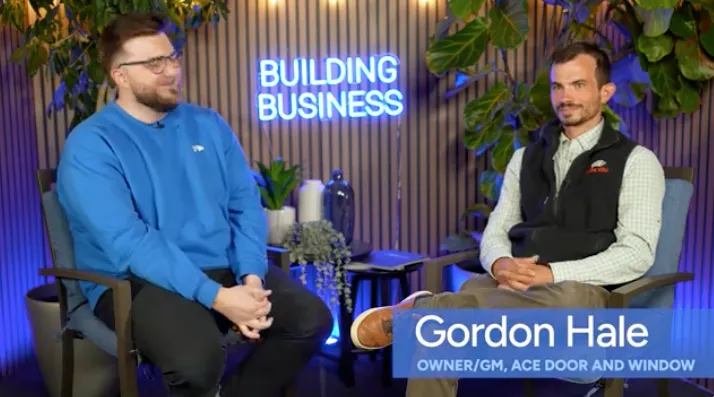
Gordon Hale didn't set out to double his family’s business in five years. When he took over Ace Door and Window in 2020, he was just trying to keep his head above water. The company that his father and uncle built in 1985 was doing $5 million in annual revenue, but Gordon knew something had to change. He wasn't interested in working harder. He needed to work smarter.
Five years later, Ace Door and Window crossed the $10 million mark. The journey came from making deliberate shifts in how the business operated, who ran it, and what systems supported it. This is the story of how one contractor doubled his revenue by changing everything except the quality of his work.
The Starting Point: Stability Over Growth
When Gordon took over in 2020, growth wasn't the goal. Survival was. He'd spent years working in the business, installing doors and windows, learning the trade from his father. But running the company was different. He had to figure out how to manage employees, handle their concerns, and keep operations moving without doing everything himself.
For the first two years, revenue stayed flat. The company hovered between $5 million and $6 million. Gordon wasn't pushing for more. He was learning what it meant to lead, not just do the work.
“I’d never really run the business,” Gordon explains. “I had run some jobs and sold some commercial jobs, but I hadn't managed all the employees and all their concerns. That was overwhelming for sure in the beginning.”
The lesson here is simple but often overlooked: before you can scale, you need stability. Gordon spent those early years building the foundation that would eventually support $10 million in revenue. He wasn't stagnant. He was preparing.
Watch the Full Podcast Video
The First Big Shift: Letting People Do Their Jobs
The biggest mental shift Gordon made wasn't about strategy or marketing but delegation. For years, he'd been the person who did everything. When he found mistakes, he'd fix them himself rather than tell the person who made them. It was faster, and it kept things moving. But it also meant his team never learned.
“Before, when I'd find mistakes, I used to just want to go and fix them," Gordon says. "I wouldn't sometimes even tell people about their mistakes. I would just go fix it because I knew it was a mistake, and I'm like, ‘They're busy doing something else. I'll just go fix it.’”
That approach doesn't scale. If you're the only person who can fix problems, you become the bottleneck. Gordon realized that if he wanted his team to operate independently, he had to let them make mistakes and learn from them.
“If I want them to not make these mistakes, I need to tell them about their mistakes, and I need to let them fix their mistakes, not me fix it,” he explains. “That's just life.”
This shift required trust and accepting that some mistakes would hurt more than others. But it also meant building a team that could handle problems without Gordon. That's the difference between a business that depends on the owner and one that can grow beyond them.
Building the Right Team: Accountability Over Availability
Gordon didn't inherit a team ready to scale. Many of the employees were there for a paycheck, not a mission. They showed up, did their work, and went home. There was nothing wrong with that, but it wasn't going to get the company to $10 million.
The turning point came when some of those employees left on their own. It left Gordon in a tough spot, but it also gave him an opportunity. He could hire differently this time. He could look for people who wanted to be part of something bigger.
“One by one, I interviewed people, and I just tried to see what their visions were, what kind of person they were, what kind of morals they had,” Gordon says. “And one by one, I just find someone and bring them on.”
He wasn't just looking for skills. He was looking for people who would take ownership of their part of the business. People who would consider the person after them in the workflow and make sure they weren't making their job harder. People who were open to feedback and willing to give it.
“Is that new hire considering the person that they hand it off to and how it affects them, and making sure that we're not making their job harder?” Gordon asks.
Building the right team doesn't happen overnight. It happens one hire at a time, with a clear understanding of what you're looking for and the patience to wait for the right person. Gordon’s team didn't transform in a year. It took five years of steady, intentional hiring to build a team capable of supporting $10 million in revenue.
The Technology Shift: from QuickBooks to a Real CRM
For years, Ace Door and Window ran on QuickBooks Desktop. It wasn't designed for what they were trying to do, but they made it work. Estimates, payments, job statuses—everything lived in QuickBooks, even though it wasn't built for any of it.
“We were trying to get QuickBooks to do stuff it's not meant to do, like collecting payments and online payments and statuses,” Gordon recalls. “I was trying to put statuses on job invoices to know where jobs were, and it was just horrible.”
The shift to JobNimbus changed everything. Suddenly, information lived in one place, notes were visible to everyone who needed them, photos were organized, and estimates could be created from anywhere. The team could work from home if needed, without clunky workarounds.
“When we started using the CRM, and everyone had access to it, I was like, ‘Wow, I can't believe I was doing it the way I was doing before,’” Gordon says.
The transition wasn't easy. Moving a company from one system to another while work doesn't stop is like moving houses with kids. It's chaotic, stressful, and you wonder if you made the right decision. But Gordon knew it was necessary. The old system couldn't support the growth he wanted.
“It's a lot. It's a huge change,” he admits. “But I knew it was the right decision.”
Technology doesn’t solve problems on its own. But the right technology removes friction, makes it easier for your team to do their jobs well, and creates visibility so nothing falls through the cracks. For Ace Door and Window, that meant JobNimbus. The key is recognizing when your current system is holding you back and having the courage to make the switch.
The Process Shift: Streamlining Estimating and Follow-Up
One of the biggest bottlenecks in the business was estimating. Before JobNimbus, creating a quote was slow and clunky. It required being in the office, using specific software, and manually tracking everything. If someone wanted to work from home or create an estimate on the road, it was nearly impossible.
JobNimbus changed that. The team could create estimates from anywhere. The process was faster, cleaner, and more consistent. That meant more quotes going out, faster response times, and fewer leads slipping through the cracks.
“Our estimates were online. People could write quotes from home,” Gordon explains. “Some people sometimes like to work from home, and they were doing all kinds of clunky stuff, but with JobNimbus, they could just work from home, get estimates out way quicker.”
Speed matters in contracting. The first company to respond often wins the job. By streamlining the estimating process, Ace Door and Window could respond faster than their competitors. That alone made a significant difference in their close rate.
But JobNimbus gave them more than speed. It gave them consistency. With everything in one system, the team could follow up systematically, see where every lead was in the pipeline, and track which leads needed attention and which ones were ready to close. Nothing got lost.
The Leadership Shift: Listening and Implementing
Gordon didn’t scale the business by having all the answers. He scaled it by listening to his team and implementing their feedback. He held regular meetings, even when it felt like too many. He asked his team what was going wrong, what they needed, and what they thought could be improved.
“I do a lot of meetings with my employees,” Gordon says. “Sometimes I do so many meetings that I'm like, ‘Man, do I need to do all these meetings?’ But every time I think that, my next meeting is one of the most constructive meetings I've had.”
Those meetings solved problems Gordon didn't even know existed because they revealed inefficiencies he couldn’t see from his position. They gave his team a voice and made them feel invested in the company’s success.
“You could solve so many problems by doing that,” Gordon explains. “Problems you may have not even known existed. And then you fix that problem. And then you stand back and look, and you're like, ‘Oh man, they're operating so much more efficiently doing XYZ, and now I see their struggles. I didn't even know they were dealing with that.’”
Leadership isn't about having all the answers, but about creating an environment where the answers can emerge. Gordon's willingness to listen and implement feedback built trust with his team. It made them feel valued. And it made the business better.
The Goal: $10 Million
For years, Gordon and his co-owners talked about hitting $10 million. It was always in the background, a goal they wondered if they’d ever reach. But in 2024, Gordon made it official.
“I was like, you know what, everybody, we’re going for 10 million,” Gordon recalls. “And they did it, and it was really spectacular.”
The goal wasn't arbitrary. It represented a doubling of revenue from where Ace Door and Window started in 2020. It required every shift Gordon had made over the previous five years: better delegation, a stronger team, streamlined processes, the right technology, and consistent leadership.
But it also required something else: belief. The team had to believe it was possible, see the vision, and commit to making it happen. When Gordon announced the goal, they didn't just nod and go back to work. They bought in and made it their goal too.
Clear, ambitious goals align the team, create focus, and turn a collection of individuals into a unified force working toward the same outcome.
The Mistakes: Looking the Other Way
Gordon is quick to admit his mistakes. One of the biggest was avoiding problems he didn’t want to deal with, like employees who were doing an okay job but not a great one, and issues he knew existed but didn't address because they weren’t causing major problems.
“Sometimes I'm dealing with problems that I don't like to deal with, so I just brush them under the rug,” Gordon admits.
The cost of avoiding problems is high. It wastes time, both yours and theirs, and prevents the business from reaching its potential. And when you finally make the change, you always wish you’d done it sooner.
“When you made the switch, when that person is gone, and I put the new person in that role, every time, I'm like, ‘Gosh, I should have done this sooner,’” Gordon says.
The lesson is simple: don’t look the other way. Address problems when you see them. Have the hard conversations. Make the tough decisions. Your business will be better for it, and so will your team.
The Advice: Stay Teachable
If Gordon could go back and give his 2020 self one piece of advice, it would be this: stay teachable, keep learning—don't assume you have all the answers.
“You have to stay teachable, and you have to continue to learn,” Gordon says. “The brain is a muscle, and you got to exercise it.”
He doesn't see himself as a genius. He sees himself as someone who applies himself, seeks out information, and learns from others. That mindset has been critical to his success.
“There's so much information out there that you can learn just about small business owners and how they’re breaking through their struggles,” Gordon explains. “You don’t need to have a college degree. You just have to have the discipline.”
The contracting industry is evolving. Technology is transforming how businesses operate. Customer expectations are rising. The companies that thrive will be the ones that adapt, stay curious, and keep learning. Gordon's story is proof of that.
The Future: Technology and Efficiency
Looking ahead, Gordon sees technology as the key to continued growth. He’s not interested in being the biggest company in his market. He’s interested in being the most efficient, professional, and trusted.
When asked about the future, Gordon says, “You have to use technology because you have to be efficient because your competition is efficient, and you got to stay current with your competition.”
He’s not talking about technology for technology’s sake. He's talking about tools that make his team more effective, his customers happier, and his business more profitable. These are tools that give his employees a better quality of life by making their jobs easier and build trust with customers by showing that the company is well-run and professional.
“Customers know when a company’s not run well,” Gordon explains. “It's not hard to figure out. You're not fooling them, and they'll pick up on it pretty quick, and your reviews and your leads will reflect that.”
The Takeaway: It's About Systems
Gordon's journey from $5 million to $10 million was about building better systems. It was about letting go of control, trusting his team, investing in the right technology to remove friction, listening to feedback, and making changes based on what he learned.
Most importantly, it was about patience. The first two years were about stability, not growth. The next three were about steady, intentional improvement. There was no magic moment, no single breakthrough, just a consistent, disciplined execution of the fundamentals.
If you’re running a contracting business and want to scale, the path is clear. Build the right team. Invest in systems that support them. Delegate effectively. Listen to feedback. Stay teachable. And be patient. Growth doesn’t happen overnight, but it does happen if you're willing to do the work.
Gordon Hale proved it. And if he can do it, so can you.
Frequently Asked Questions (FAQs)
Q: How do you scale a contracting business from $5M to $10M?
A: Scaling past $5M means working smarter. First, you have to prioritize stability over growth to build a solid foundation. From there, the magic happens when you stop doing everything yourself. You have to step out of the daily hustle, delegate tasks, build a team that shares your vision, and adopt the right technology to remove friction. When you stop acting as the bottleneck, your business finally has the room to double.
Q: When should a contractor switch from QuickBooks to a specialized CRM?
A: If you find yourself forcing QuickBooks to track job statuses, organize project photos, or handle field estimates, it’s time to switch. QuickBooks is great for accounting, but using it to run your daily operations is clunky and creates massive bottlenecks. You need to migrate to a specialized CRM the moment your current setup starts holding you back from working efficiently on the road or from home.
Q: How does a CRM like JobNimbus help contracting businesses grow?
A: JobNimbus fuels growth by pulling your entire business into one single source of truth. Instead of hunting down notes or losing track of job stages, your whole team can see estimates, photos, payments, and project updates in real time. This central hub eliminates messy hand-offs, lets your team send quotes from anywhere, speeds up response times, and shows homeowners that you run a tight, professional ship.
Q: What is the biggest operational bottleneck when growing a contracting company?
A: Honestly? It’s usually the owner. When you're the only person who can fix mistakes or approve next steps, you become the ultimate bottleneck. True scaling requires letting go of control, trusting your team, and letting people fix their own mistakes so they can actually learn. If you want to grow past $5M, you have to shift from a hands-on fixer to a leader who empowers an accountable team.
Q: How do field estimating and systematic follow-up impact close rates?
A: In the contracting world, speed wins the job. If your estimating process is tied to an office desktop or a clunky system, you’re losing money. Moving your estimating to the cloud lets your team send clean, consistent quotes instantly from anywhere. Paired with a solidified follow-up process, you ensure that no lead ever slips through the cracks, your response times drop, and your close rates skyrocket.


Blog / Guide Title CTA
Once you've created a strong Linkedin profile, you can leverage it as part of your broader marketing strategy. Use your Linkedin to share content, join industry groups, and network with others in the contracting space.
If you're looking for additional marketing support, consider partnering with JobNimbus Marketing to maximize your business growth. Schedule a call with our team to learn how to boost your marketing efforts today.
Blog / Guide Title CTA
Once you've created a strong Linkedin profile, you can leverage it as part of your broader marketing strategy. Use your Linkedin to share content, join industry groups, and network with others in the contracting space.
If you're looking for additional marketing support, consider partnering with JobNimbus Marketing to maximize your business growth. Schedule a call with our team to learn how to boost your marketing efforts today.
Download Our Free Tips for Recession-Proofing Your Company
We’ll show you five simple things you can do to help your business survive a recession.