

Table of Contents

Win more bids. Close more jobs. Start with our newsletter.
Get exclusive insights, tips, and trends your competition doesn't want you to know.

Updated on July 20, 2026
Every roofing job comes down to the details. Miss one component in your documentation and it shows up later as a change order you eat, a claim that stalls, or an estimate that runs short on materials. Logging every part of a roof is not busywork. It is how you protect the margin you earned on the job.
This guide breaks down exactly what to log on every roof, why it matters more in 2026 than ever, and how to build a system your crew will actually use in the field.
Quick Answer
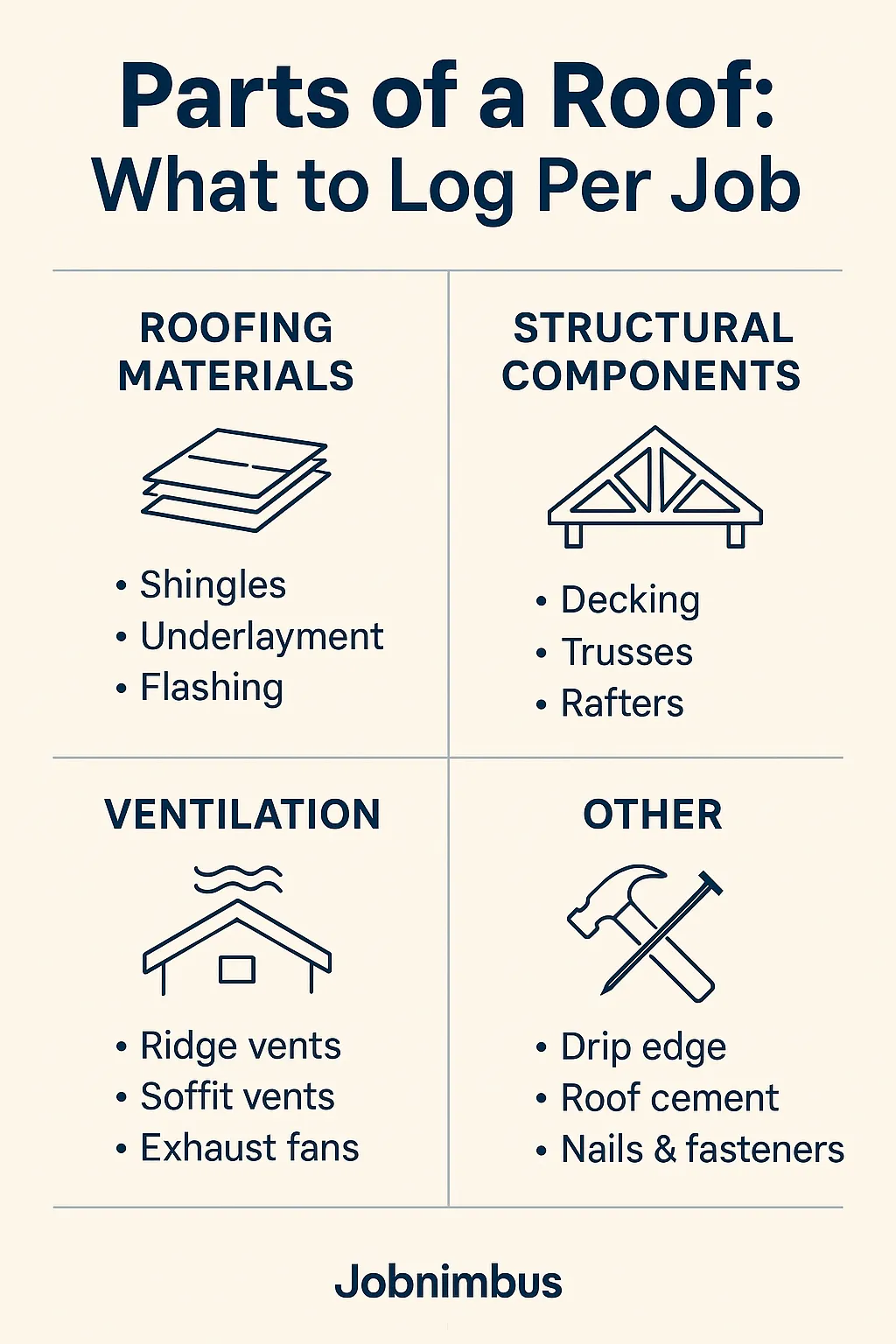
On every job, log four groups of roof parts: structural elements (decking, trusses, and rafters), the weather barrier (underlayment, ice and water shield, and flashing), surface materials (shingles or panels, drip edge, and ridge caps), and ventilation (ridge vents, soffit vents, and exhaust). For each part, record the type, brand, quantity, measurements, and condition, and back it up with photos. Detailed logs protect your margins, speed up insurance approvals, and keep your estimates accurate.
Key Takeaways
✓Log every roof part in four buckets: structure, weather barrier, surface materials, and ventilation.
✓Record type, brand, quantity, measurements, and photos for each component while you are on site.
✓Clean logs protect your margin as material prices climb, and they speed up insurance claims when hail hits.
✓A shared system keeps field notes, job costs, and estimates in one place, so nothing gets lost between the roof and the office.
Why does logging every roof part protect your profit?
Documenting each component is how you stop small misses from quietly eating your margin. When a part is not on the record, it turns into money you cannot bill for: change orders customers dispute, insurance line items that get kicked back, and estimates that come up short on materials.
That margin is harder to hold onto right now. Homeowners can expect to pay 15% to 25% more for a roof replacement in 2026 than they did in 2024, driven by material price inflation and tariffs, according to a 2026 roofing cost analysis citing National Roofing Contractors Association data. When materials cost more, an undocumented bundle of shingles or a missed run of flashing hits your bottom line harder than it used to.
The numbers show discipline pays. Most roofers make 21% to 40% gross profit, but only the ones who track job costs weekly and use automation stay consistently above 30%, per JobNimbus Peak Performance 2026. Logging parts per job is where that weekly job costing starts. If you want to see those costs add up in real time as you go, that is exactly what Profit Tracker is built for.
What roof components should you log on every job?
Capture four categories on every roof: structural elements, the weather barrier, surface materials, and ventilation. The table below is a field-ready checklist you can copy into your own job template.
Start with the structure. Decking, trusses, and rafters seem basic, but this is where scope creep hides. Note every repair, because 'while we are up there' work is what quietly destroys a margin.
Next, log the weather barrier. Underlayment, ice and water shield, and flashing are where most disputes start. Record the type, brand, and square footage of every piece. When an adjuster questions your estimate six months later, that detail is what wins the argument.
Then capture surface materials. Document the brand, color, and any upgrade on every bundle of shingles or run of panels. This is also where material trends matter: residential metal roofing shipments are projected to more than double, from 18% to 37% market share, per Peak Performance 2026. If you are logging panels and coatings more often, your template should already have a spot for them. For a deeper breakdown of options, see our guide to residential roofing materials.
Finally, do not skip the small stuff. Drip edge, ridge vents, roof cement, and fasteners feel minor, but they add up fast across a full job.
How do storms and rising costs raise the stakes on documentation?
When claims and material costs climb, your logs are the proof that gets you paid fairly. Roofs take the brunt of severe weather, and that weather is getting more expensive.
Severe convective storms, which include hail, tornadoes, and straight-line winds, caused 51 billion dollars in U.S. insured losses in 2025, the third straight year above 50 billion dollars, according to the Insurance Information Institute. Everyday hail is a bigger share of the work, too: non-catastrophic wind and hail roof claims rose from 17% to 25% of all residential claims between 2022 and 2024, and roofing line items now make up more than a quarter of all residential claim value, based on Verisk data reported in 2026.
More claims plus pricier materials means adjusters look harder at every line. Photos of the existing damage, notes on what you tore off, and a clear record of what you installed are what move a claim from 'under review' to 'approved.'
How does JobNimbus turn field notes into faster cash flow?
JobNimbus keeps your documentation, estimates, ordering, and payments connected, so nothing gets lost between the roof and the office. The point is not to store data for its own sake. It is to move that data straight into the parts of the job that get you paid.
Your crew logs components and snaps photos from the field on the JobNimbus Mobile App, so the record is built while they are on the roof, not from memory back at the shop. From there, you can order materials directly from your suppliers, including ABC Supply, SRS, and QXO, which cuts double entry and ordering mistakes. Those same logged components feed your Estimates, so your next bid is based on what the job actually takes. When the work is done, you collect through Payments and can offer Financing to help homeowners say yes.
Doing this by hand is where things fall through the cracks, which is why automation has taken off. Automation use nearly doubled year over year, 79% of roofers now use a CRM, and roofers running three or more automations report fewer missed steps, faster production, and smoother handoffs, per Peak Performance 2026.
How do you build a roof documentation system your crew will use?
Keep it simple: give crews a standard checklist and let them log everything from their phones. A system only works if the people on the roof will actually follow it.
Build a template for each common roof type so crews know exactly what to capture before they climb down. Make photos part of the routine, not an afterthought. And connect the 'why' for your team: every part they log correctly leads to more accurate estimates and fewer callbacks, which shows up in their own paychecks.
The payoff keeps coming after the job closes. When a homeowner calls about a leak three years later, a complete log lets you pull up every part installed and pinpoint what needs attention. That kind of follow-through is what earns the review and the referral.
Poor documentation quietly drains money from good roofing businesses. Tighten up what you log per job, put it in one system, and you keep more of what you earn. Ready to see how it works on your next job?
Start a free trial and build your first job template today!

Frequently Asked Questions
The main parts of a roof fall into four groups: structural elements (decking, trusses, and rafters), the weather barrier (underlayment, ice and water shield, and flashing), surface materials (shingles or metal panels, drip edge, and ridge caps), and ventilation (ridge vents, soffit vents, and exhaust fans). Logging all four on every job keeps your estimates accurate and your insurance claims defensible.
On every job, record the type, brand, quantity, measurements, and condition of each roof component, and take photos before, during, and after the work. Capture structural repairs, underlayment and flashing details, shingle or panel specs, and ventilation counts. This level of detail prevents disputed change orders and speeds up insurance approvals.
Adjusters approve claims faster when you can prove what was damaged and what you installed. With roofing line items making up more than a quarter of residential claim value and hail claims rising, clear photos and a complete parts log are what move a claim from under review to approved.
A roofing CRM like JobNimbus lets crews log components and photos from the field on a Mobile App, then feeds that record into estimates, material ordering, and invoicing. That keeps job costs and documentation in one place, so nothing gets lost between the roof and the office.

Blog / Guide Title CTA
Once you've created a strong Linkedin profile, you can leverage it as part of your broader marketing strategy. Use your Linkedin to share content, join industry groups, and network with others in the contracting space.
If you're looking for additional marketing support, consider partnering with JobNimbus Marketing to maximize your business growth. Schedule a call with our team to learn how to boost your marketing efforts today.
Blog / Guide Title CTA
Once you've created a strong Linkedin profile, you can leverage it as part of your broader marketing strategy. Use your Linkedin to share content, join industry groups, and network with others in the contracting space.
If you're looking for additional marketing support, consider partnering with JobNimbus Marketing to maximize your business growth. Schedule a call with our team to learn how to boost your marketing efforts today.
Download Our Free Tips for Recession-Proofing Your Company
We’ll show you five simple things you can do to help your business survive a recession.