

Table of Contents

Win more bids. Close more jobs. Start with our newsletter.
Get exclusive insights, tips, and trends your competition doesn't want you to know.

Growing a roofing company takes more than finding more leads. More work can expose weak spots in your sales process, put pressure on cash flow, and create new demands on a team that was already busy.
Eventually, growth requires you to change how the business operates.
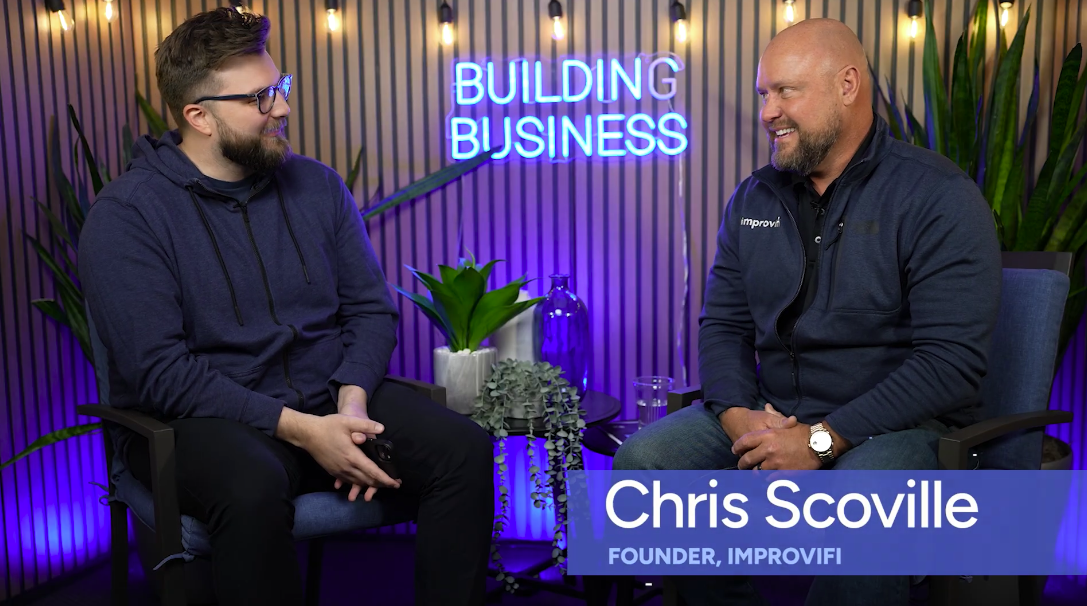
Chris Scoville has seen that transition from several angles. Before becoming CEO of home improvement financing company Improvifi, he spent decades working in roofing and finance. On the Building Business podcast, he shared some of the lessons he’s learned about serving homeowners, increasing access to financing, using technology, and making the shift from roofer to business owner.
His experience points to a bigger lesson: You can’t scale by doing more of everything. You have to build a business that can handle more.
Watch the full episode
Make it easier for homeowners to do business with you
Chris’s approach starts with a straightforward principle: Help the homeowner as much as you can at the point of sale.
Roofing companies often think about competition in terms of price, reputation, materials, or warranties. Those things matter, but homeowners also experience the process of buying from you. Every unnecessary obstacle gives them another reason to hesitate.
Solve more than the roofing problem
A homeowner with a failing roof doesn’t only have a roofing problem. They have decisions to make about the scope, contractor, timing, materials, and how they’re going to pay for it. Your sales process should help them work through those decisions rather than simply hand them an estimate.
Financing is one way to remove a potential roadblock. Giving homeowners payment options at the point of sale can help them evaluate what works for their budget without forcing your salesperson to guess what they can afford.
The larger principle extends beyond financing. Look for places where your sales process makes the homeowner do unnecessary work. Make it easier for homeowners to choose you by providing clear proposals, responsive communication, convenient payment options, and an organized sales experience.
Give homeowners somewhere to go after a "no"
Financing can create its own dead end when contractors depend on a single lender.
Chris recommends what he calls a “lending ladder”: multiple lending options that can serve homeowners with different credit profiles. If one option doesn’t work, the homeowner may still have another path forward.
A lending ladder still won’t guarantee that every homeowner will qualify, but it does give your team more opportunities to help before a declined application ends the sale.
Train your sales team on the financing options you offer, how the application process works, and what they should do if the first option isn’t a fit.
Learn what your customers are actually buying
Two homeowners can need the same roof but approach the purchase completely differently.
Chris describes three broad types of home improvement purchases: grudge, need, and ego. These categories are a useful way to think about the motivation behind the purchase.
The grudge purchase
Some homeowners would happily spend their money on almost anything other than a new roof. But when the existing roof is leaking, damaged, or at the end of its life, they’re buying because they have to.
These homeowners may care most about solving the immediate problem without creating another one. A complicated sales pitch or aggressive push toward upgrades can make an already frustrating purchase feel worse.
The need purchase
Other homeowners have already accepted that the roof needs to be replaced. Their question isn’t whether to do the work but who should do it and what the project should include.
Your reputation, communication, proposal, financing options, and overall professionalism can all influence that comparison.
The ego purchase
The last category of homeowners sees the project as an opportunity to improve their homes. They may care about curb appeal, premium products, warranties, or building a roofing system they feel confident in for years to come.
These homeowners may be more open to upgrades, but the goal isn’t to push them toward the most expensive option. Show them what’s possible and give them enough information to choose what matters to them.
Understanding the motivation behind the decision helps your team have a better conversation. Instead of delivering the same pitch at every kitchen table, reps can spend more time addressing what homeowners actually care about.
Stop treating every roofer like the enemy
Roofing is competitive, but other roofers don’t always have to be the enemy. Roofing companies serve the same industry, face many of the same challenges, and often have knowledge or resources that can help one another.
A contractor may encounter work that isn’t a good fit because of geography, project type, capacity, or timing. Knowing reputable contractors gives you someone to send those opportunities to, and the relationship can work in both directions.
Connections with other contractors can also give business owners other people to learn from. Someone else may have already solved a hiring problem, tested a sales strategy, adopted a piece of technology, or made an expensive mistake you can avoid.
You don’t have to hand over your playbook to every competitor in town. But treating the entire industry as a zero-sum game can cut you off from relationships that could make your own company stronger.
Make the shift from roofer to CEO
The skills that help someone build a roofing company aren’t always the same skills they need to scale it.
Early on, an owner may sell jobs, answer calls, inspect roofs, solve production problems, collect payments, and make nearly every important decision. That level of involvement can keep a young business moving. It can also become the thing that eventually limits it.
As your company grows, the goal is to make the business less dependent on what one person can remember or accomplish in a day. Technology can help you outsource some of that memory and create more capacity across your team.
Build a company that doesn't depend on your memory
As the company grows, important information can’t live in just the owner’s head.
Your team needs reliable ways to know what’s happening with leads, jobs, customers, payments, and follow-ups. Otherwise, adding more work also means adding more opportunities for missed calls, forgotten tasks, duplicated effort, and confusion.
Technology can help create that visibility. A roofing CRM gives your team a shared place to track the information they need instead of piecing it together from spreadsheets, paper, individual inboxes, or someone’s memory.
Use technology to create capacity
Software alone won’t scale a roofing company. The value comes from what your team no longer has to do manually.
Every repetitive administrative task takes time that your team could spend on work that requires their judgment, expertise, or attention. If software can keep job information organized, trigger routine follow-ups, simplify communication, or make information available from the field, your team has more capacity without necessarily adding another person.
Growth becomes more sustainable when increasing your volume doesn’t require your overhead to increase at the same rate.
Build for the company you want to become
A roofing business can grow for a while on hustle. The owner works longer, the team squeezes in another job, and everyone finds a way to keep things moving. But scaling requires something different.
The goal is to build a company that can handle more without asking the owner or team to carry more of the business in their heads. You do that by removing obstacles for homeowners, building stronger relationships, and using the right tools and processes to create capacity as you grow. Financing can be part of that equation, but as Chris explains, it’s only one piece of a much larger growth engine.
Learn more from Chris about financing, roofing, leadership, and building a business that’s ready to scale in the full episode of the Building Business podcast.
Watch the Full Episode
Want to learn more about Improvifi and how to set up financing for your roofing business? Visit improvifi.com or schedule a demo at scheduling.improvifi.com/widget/bookings/improvifi-demo.
Ready to Run a Smarter Roofing Business?
JobNimbus gives contractors the tools to manage jobs, communicate with customers, track payments, and grow — all in one place.

Frequently Asked Questions
Offering financing at the point of sale removes the biggest barrier between a homeowner and a signed contract — upfront cost. When a homeowner can break a $20,000 roof into a manageable monthly payment, price objections drop and close rates go up. It also speeds up cash flow: instead of waiting 60 to 90 days for a homeowner to "think about it" or arrange their own financing, you get paid as soon as the job is complete. With Millennial and Gen Z homeowners now making up the largest share of the market, financing is increasingly an expectation, not a bonus — contractors who offer it win jobs that others do not even get a chance to close.
A Lending Ladder is a financing strategy where a contractor partners with multiple lenders across different credit tiers so that nearly every homeowner qualifies for some form of financing. Instead of relying on a single lender — and losing the job when that lender declines a customer — you move the homeowner down the ladder to the next tier until you find a product that works. The result is a near-100% approval rate across your customer base. Building a Lending Ladder means identifying lender partners at the prime, near-prime, and subprime levels, training your sales team to present each option smoothly, and making financing a standard part of every proposal rather than a last resort.
Not every homeowner thinks about a roof the same way, so a one-size-fits-all pitch will cost you jobs. There are three buyer types to recognize. The first is the grudge buyer — someone who does not want a new roof but needs one. They care about minimal disruption and cost, so keep the pitch simple and use financing to make the unavoidable feel manageable. The second is the need buyer — someone who has accepted the purchase and is comparing contractors. Here, offering financing sets you apart as a professional, modern business and gives them a reason to choose you. The third is the ego buyer — someone who wants the best and sees their home as an investment. Financing is the key to unlocking the full scope of what they actually want, because it lets them choose premium materials without draining their savings. Identifying which type of buyer you are working with early in the conversation changes everything about how you close.

Blog / Guide Title CTA
Once you've created a strong Linkedin profile, you can leverage it as part of your broader marketing strategy. Use your Linkedin to share content, join industry groups, and network with others in the contracting space.
If you're looking for additional marketing support, consider partnering with JobNimbus Marketing to maximize your business growth. Schedule a call with our team to learn how to boost your marketing efforts today.
Blog / Guide Title CTA
Once you've created a strong Linkedin profile, you can leverage it as part of your broader marketing strategy. Use your Linkedin to share content, join industry groups, and network with others in the contracting space.
If you're looking for additional marketing support, consider partnering with JobNimbus Marketing to maximize your business growth. Schedule a call with our team to learn how to boost your marketing efforts today.
Download Our Free Tips for Recession-Proofing Your Company
We’ll show you five simple things you can do to help your business survive a recession.