


Table of Contents

Win more bids. Close more jobs. Start with our newsletter.
Get exclusive insights, tips, and trends your competition doesn't want you to know.

Accurate financials are essential to running a profitable roofing business. Knowing the difference between margin vs. markup helps you avoid pricing errors that could hurt your bottom line.
Margin and markup have different meanings and aren’t interchangeable. For your business to thrive, you need to understand the definitions of margin vs. markup and the difference between them.
You don’t want to offer services that are overpriced or underpriced. A pricing mismatch in either direction could hurt your profits.
In this guide, we’ll go over the following topics:
- Defining margin vs. markup
- How to calculate margin vs. markup
- When to use margin vs. markup
Let’s dive in.
Your guide to understanding markup vs. margin
What is the difference between markup vs. margin?
To know when to use margin vs. markup, you first need to understand what these terms mean.
While margin and markup have the same inputs (cost and sales), they aren’t the same.
Markup is the amount you charge a client in addition to the cost of your goods or services sold. A margin is the amount you keep out of total revenue after accounting for the cost of goods or services sold.
The margin and markup can be the same dollar amount, but the percentages will differ significantly.
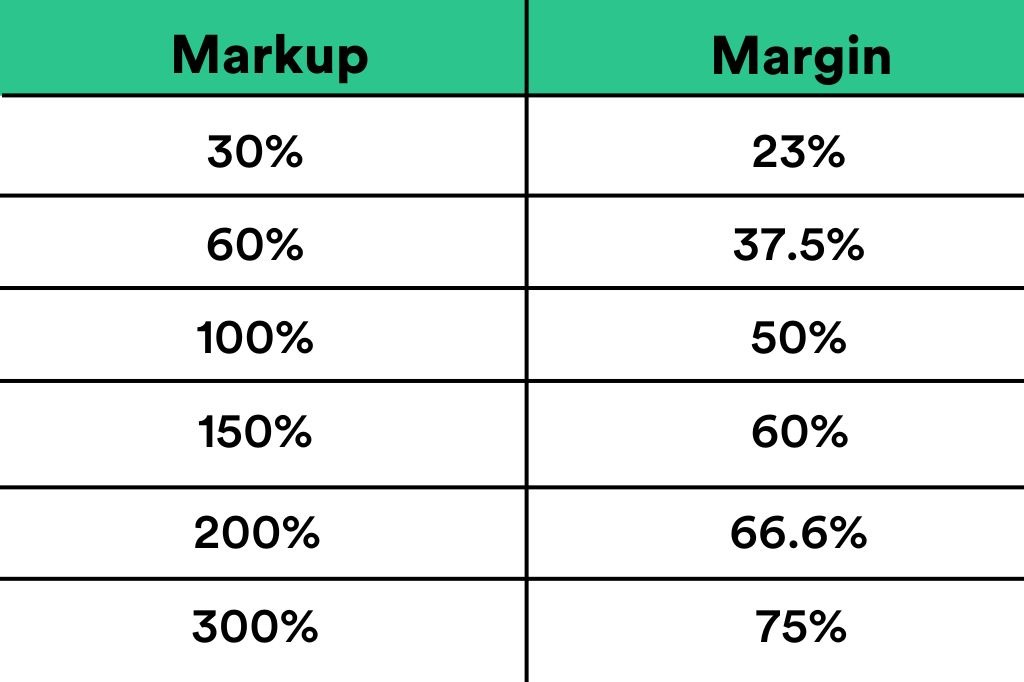
For example, if you sell a roofing service for $100, and your cost is $25, the markup and margin are both $75. However, the markup is 300%, and the margin is 75%.
That’s why you should calculate the markup and margin as percentages to understand the full value.
Markup vs. margin formula
To find both your margin and markup, you’ll need to know the following inputs:
- Sales
- Cost of the services/goods sold
Here’s how to calculate margin vs. markup using these formulas:
- Markup formula: (Sales - Cost of services sold) / Cost of services sold = Markup
- Margin formula: (Sales - Cost of services sold) / Sales = Margin
To determine the markup needed to achieve a desired margin, use the following formula:
- Markup % = Margin % / (1-Margin %)
Once you've calculated the markup percentage, multiply the cost by (1 + markup percentage) to determine the sales price. For example, if your desired margin is 30% and your cost is $100, you'll need a markup of 42.9%, resulting in a sales price of approximately $142.90.
Additionally, when you know the markup, you can calculate the margin and vice versa. If it’s easier, some online sites offer free margin vs. markup calculators. You can also keep a markup vs. margin conversion cheat sheet handy to save time.
As your margin grows, the markup increases at an even greater rate. A margin vs. markup chart can help you quickly convert between the two percentages without manually performing calculations each time. Take a look at the markup vs. margin conversion chart below as a starting point for your conversion cheat sheet.
When to use margin vs. markup
For calculating business profits, using margin instead of markup is best. Margin will also give you a good view of your service's profitability. However, markup is helpful to look at when determining your pricing.
See the difference between margin vs. markup
Understanding markup and margin is critical when building professional estimates. JobNimbus helps contractors create accurate estimates, manage costs, and keep projects profitable by connecting sales, production, and financial data in one place.
See how JobNimbus helps contractors build more profitable estimates today.

Frequently Asked Questions
Markup is the amount you charge a client in addition to the cost of your goods or services sold. Conversely, a margin is the amount you keep out of total revenue after accounting for the cost of goods or services sold. While they share the same inputs, the resulting percentages differ significantly.
It is best to use margin when calculating your business profits because it provides a clear view of your service's profitability. However, markup is more helpful to look at when you are determining your initial pricing.

Blog / Guide Title CTA
Once you've created a strong Linkedin profile, you can leverage it as part of your broader marketing strategy. Use your Linkedin to share content, join industry groups, and network with others in the contracting space.
If you're looking for additional marketing support, consider partnering with JobNimbus Marketing to maximize your business growth. Schedule a call with our team to learn how to boost your marketing efforts today.
Blog / Guide Title CTA
Once you've created a strong Linkedin profile, you can leverage it as part of your broader marketing strategy. Use your Linkedin to share content, join industry groups, and network with others in the contracting space.
If you're looking for additional marketing support, consider partnering with JobNimbus Marketing to maximize your business growth. Schedule a call with our team to learn how to boost your marketing efforts today.
Download Our Free Tips for Recession-Proofing Your Company
We’ll show you five simple things you can do to help your business survive a recession.