


Table of Contents

Win more bids. Close more jobs. Start with our newsletter.
Get exclusive insights, tips, and trends your competition doesn't want you to know.

Updated June 4, 2026
When your next big project could be right around the corner, showing up on Google Maps isn't just nice—it's necessary. As a roofing business owner, you've probably noticed how much the industry has changed. Word-of-mouth still matters, but these days, your digital presence on local searches determines whether homeowners find your business or your competitor's.
In fact, 86% of people look up a business location on Google Maps before visiting for the first time, and local searches lead to 28% of conversions within 24 hours (Google, 2025). That means when someone in your area needs a roof repair, your visibility on Google Maps directly impacts whether your phone rings.
Let's break down the fundamentals of local SEO for contractors and how you can position your roofing business to show up when and where it matters most.
Key Takeaways
- Google Business Profile optimization is crucial—complete profiles receive 7x more clicks than incomplete ones, with properly categorized and keyword-rich descriptions making the biggest impact.
- Reviews create a feedback loop for rankings—businesses with 15+ recent 4-5 star reviews appear in the local "map pack" results 70% more often than those with few or negative reviews.
- Consistent NAP (Name, Address, Phone) information across all online platforms is a top-3 local ranking factor. Even minor inconsistencies can cut your visibility by up to 40%.
- Local keyword optimization requires a different approach than general SEO. Neighborhood names, city-specific terms, and "near me" optimization can increase your map visibility by 35%.
- Regular Google Business Profile activity (posts, photo updates, Q&A responses) signals to Google that your business is active and relevant—businesses that update weekly see 380% more views.
What is Local SEO and Why Does it Matter for Contractors?

Local SEO is your digital storefront in Google's local marketplace.
Local SEO focuses on optimizing your online presence to attract business from relevant local searches. Unlike general SEO that might target nationwide audiences, local SEO prioritizes visibility in specific geographic areas—crucial for contractors who serve particular communities.
For roofing companies, local SEO is the difference between showing up prominently when someone searches "roofing contractor near me" and being buried on page five where no one will find you. It targets the specific moment when a homeowner has a leak, storm damage, or is planning a roof replacement and turns to their phone for an immediate solution.
Local SEO matters more than ever for contractors because:
- 97% of consumers search online for local businesses, with 46% of all Google searches having local intent
- 72% of consumers who perform a local search visit a store within 5 miles of their current location
- Local searches lead to purchases 28 times more often than non-local searches
- 88% of consumers trust online reviews as much as personal recommendations when choosing local businesses
The financial impact is significant too. According to a 2025 industry report, contractors with optimized Google Business Profiles generate up to 63% more leads than those without, and conversion rates on these leads average 18% higher (Footbridge Media, 2025).
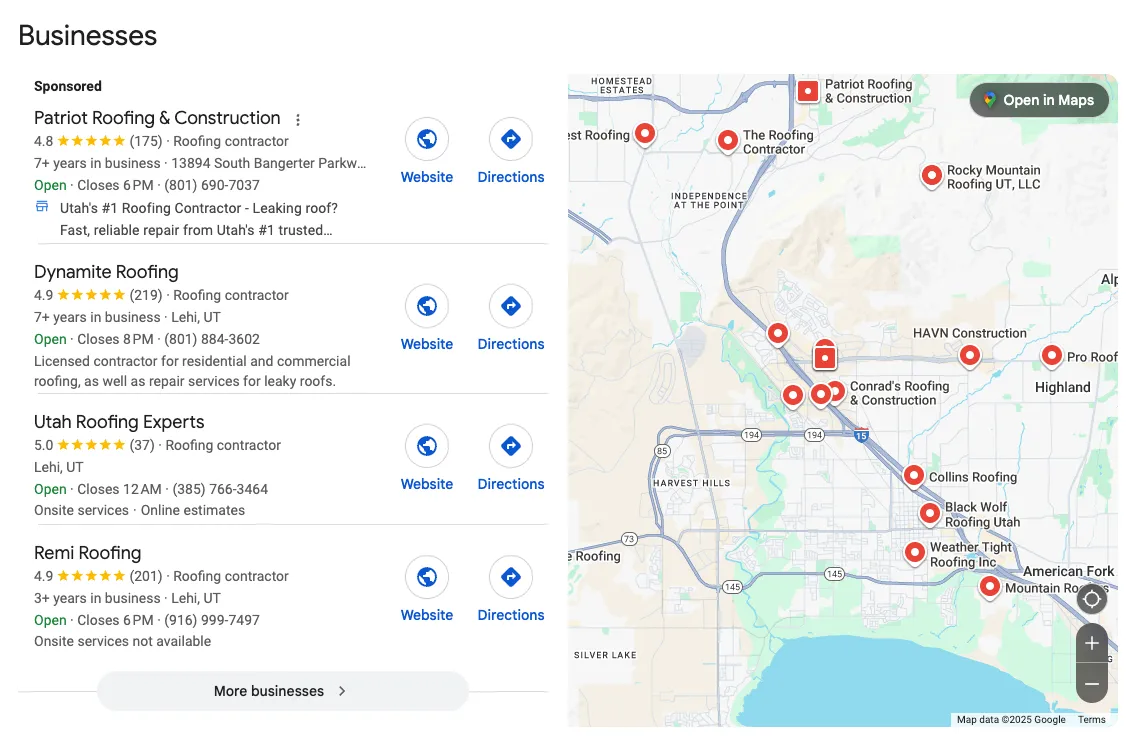
The Google Map "3-pack"—those three business listings with the map that appear at the top of local search results—has become prime real estate. These listings receive 44% of all clicks for local searches, with the remaining results sharing the leftovers. For contractors who depend on local customers, ranking in this map pack isn't just about visibility—it's about business survival.
Learn more about dominating local searches as a roofer
How Does Google Determine Which Contractors Show Up on Maps?
Google ranks local businesses using proximity, relevance, and prominence.
Google uses a unique algorithm for local search rankings that differs from its regular search algorithm. For contractors, understanding these ranking factors helps you prioritize your local SEO efforts effectively.
The three primary pillars of Google's local ranking system include:
- Proximity - How close your business is to the searcher or the location specified in their search
- Relevance - How well your business profile matches what the user is searching for
- Prominence - How established and trustworthy your business appears online
While proximity is somewhat out of your control, relevance and prominence are areas where contractors can make significant improvements. Google's 2025 local ranking updates have placed even more emphasis on Google Business Profile activity, photo uploads, and review responses as signals of an active, trustworthy business.
Specific factors that affect your Google Maps ranking include:
- Complete and accurate Google Business Profile information
- Consistent NAP (Name, Address, Phone) details across the web
- Positive customer reviews and owner responses
- Local backlinks from reputable websites
- On-page SEO signals (local keywords, location pages)
- Social signals and online engagement
- Behavioral signals (click-through rates, mobile calls, direction requests)
For contractors, industry-specific ranking factors also come into play:
According to a 2025 study by GBC Digital Marketing, contractors who outperform in their local rankings typically excel in review management (responding to 90%+ of reviews within 48 hours) and visual content (uploading 5+ new project photos monthly). Additionally, the study found that contractors appearing in the top map positions updated their Google Business Profiles weekly, while those ranking lower updated quarterly or less frequently.
"Local search is increasingly competitive for contractors," notes marketing expert Josh Nelson. "The businesses that succeed are treating their Google Business Profile with the same care they would give to their physical storefront." (Altered Vision Designs, 2025)
Create your Google Business Profile with this step-by-step guide
How Can Roofers Optimize Their Google Business Profile for Maps?
Your Google Business Profile is the foundation of your local SEO success.
Your Google Business Profile (formerly Google My Business) is the cornerstone of your local visibility. For roofing contractors, an optimized GBP can single-handedly transform your lead generation efforts.
Start by ensuring your profile is 100% complete, as Google rewards businesses that provide comprehensive information. Here's your optimization checklist:
- Claim and verify your business listing
- Use your exact business name (no keywords stuffed)
- Provide your actual physical address (not a PO box)
- Use your local phone number (not a toll-free number)
- Choose the most accurate primary and secondary categories
- Add compelling visual elements
- Upload a high-resolution logo and cover photo
- Share at least 10 photos of completed projects, crews at work, and equipment
- Add videos of testimonials or time-lapse project completions
- Tag photos properly with descriptive captions
- Create a keyword-rich business description
- Focus on local terms in your 750-character description
- Highlight your service area, specialties, and experience
- Include your city and neighborhood names naturally
- Avoid keyword stuffing that sounds unnatural
- Add complete service information
- List all your services with descriptions
- Include price ranges where possible
- Add service areas with specific radius or zip codes
- Update seasonal offerings regularly
- Set accurate business hours and special hours
- Include any seasonal changes to availability
- Update for holidays and emergency response times
- Add "More hours" for specific departments if relevant
GBP DESCRIPTION TEMPLATE FOR ROOFING CONTRACTORS:
[Company Name] has proudly served [City/Region] homeowners since [Year]. As a locally-owned roofing contractor specializing in [primary services], we deliver exceptional results for [neighborhoods served]. Our team of certified professionals handles [specific project types] with expertise and attention to detail. We're known for our [unique selling proposition] and commitment to [value proposition]. From [common problem] to complete roof replacements, we're the trusted choice for [City] residents facing roofing challenges.
Beyond the basic setup, contractors should focus on these high-impact GBP features:
Google Posts - Create regular updates (at least weekly) with current promotions, recent projects, or seasonal tips. Posts with images get 120% more engagement than text-only posts.
Q&A Section - Proactively add common questions and answers about your services. This prevents misinformation and helps you control the narrative about your business.
Products/Services - Fully populate the services section with detailed descriptions of each roofing service you offer, including relevant keywords.
Review Management - Actively request reviews from satisfied customers and respond to all reviews, positive or negative, within 24-48 hours.
Messaging - Enable the messaging feature but ensure you have resources to respond promptly, as slow responses can hurt your reputation.
According to a 2025 case study by Lead Harvester, a roofing contractor in Texas saw a 43% increase in map visibility after implementing a comprehensive GBP optimization strategy, resulting in 27 additional qualified leads per month.
"Your Google Business Profile should tell your company's story visually and textually," says digital marketing specialist Sarah Stevens. "For contractors especially, before-and-after photos and detailed project descriptions help potential customers envision working with you." (Lead Harvester, 2025)
Learn more about creating the perfect local business listing
What Role Do Reviews Play in Local SEO for Contractors?
Reviews are the social proof that powers your map rankings.
Reviews might be the single most influential factor in your local SEO success as a contractor. They not only influence potential customers but directly impact your Google Maps ranking. A strategic review generation system can transform your visibility and lead flow.
The impact of reviews on local SEO is multifaceted:
- Quantity matters - Businesses with 50+ reviews rank higher on average than those with fewer
- Recency counts - Fresh reviews signal active business and relevance
- Response rate is critical - Google monitors how quickly and thoroughly you respond
- Review sentiment affects click-through - Star rating influences user behavior
- Review content provides keywords - Customer-written reviews often contain valuable local search terms
For roofing contractors, the data is compelling. According to industry research, roofing companies with 15+ recent reviews and an average rating above 4.5 stars appear in the map pack 70% more frequently than competitors with fewer or lower-rated reviews (Footbridge Media, 2025).
Here's how contractors can build a review generation system:
- Create a streamlined review request process
- Send follow-up texts or emails with direct review links
- Ask at the optimal moment (project completion, final inspection)
- Make the request personal and specific to the work completed
- Respond appropriately to all reviews
- Thank positive reviewers specifically mentioning aspects they praised
- Address negative reviews professionally with solutions
- Respond within 24-48 hours to all new reviews
- Use review management tools
- Implement automated review requests tied to job completion
- Monitor review alerts across all platforms
- Track review performance and identify trends
- Address negative reviews strategically
- Acknowledge the issue and take responsibility when appropriate
- Offer to make things right and move the conversation offline
- Follow up to ensure resolution and potentially update the review
Review Request Template:
Hi [Name],
Thank you for trusting [Company] with your recent [specific project]. We're glad to hear you're pleased with your new [roof/gutters/etc.].
Would you take a moment to share your experience with a quick review? It helps other [City] homeowners find us and lets us know how we're doing.
Simply click this link: [DIRECT GOOGLE REVIEW LINK]
Thanks again for your business!
[Your name]
[Company name]
A strategic approach to review management can dramatically impact your maps visibility. A Florida roofing contractor implemented a text-based review request system in 2025 and saw their review count increase from 23 to 87 in just four months. Their map pack visibility increased by 210% during the same period, resulting in a 43% increase in inbound leads (GBC Digital Marketing, 2025).
"Contractors often worry about asking for reviews, but our data shows that satisfied customers are happy to provide them when the process is simple," notes SEO specialist Mark Johnson. "The key is making the request personal and the process frictionless." (Altered Vision Designs, 2025)
Get a free SEO audit to see how your review strategy compares to top-performing contractors.

How Important is NAP Consistency for Contractor Map Rankings?
NAP consistency builds Google's trust in your business information.
NAP (Name, Address, Phone number) consistency might seem like a minor detail, but it has an outsized impact on your local SEO performance. For contractors who may have changed locations, phone systems, or even slightly modified their business name over the years, this can be a critical issue to address.
NAP consistency means that your business information appears exactly the same way across all online platforms, including:
- Your website (header, footer, contact page)
- Google Business Profile listing
- Directory listings and citations
- Social media profiles
- Review platforms
- Chamber of commerce listings
- Industry association memberships
Even minor inconsistencies can confuse Google's algorithms and diminish trust in your business data. The impact is real: contractors with inconsistent NAP information across the web see up to 40% reduced visibility in local search results (Altered Vision Designs, 2025).
Common NAP issues that plague contractors include:
- Using "Inc." or "LLC" in some listings but not others
- Address format differences (Suite vs. #, St. vs. Street)
- Different phone numbers on different platforms
- Old locations still appearing in some directories
- Abbreviations in some listings but full names in others
- Inconsistent business names ("Bob's Roofing" vs. "Bob's Roofing & Construction")
To audit and fix your NAP consistency:
- Document your canonical NAP information
- Decide on the exact business name, address format, and phone number to use
- Create a reference document for your team to ensure consistency
- Conduct a citation audit
- Use citation tracking tools to find all mentions of your business
- Note inconsistencies across platforms
- Prioritize high-authority directories for corrections
- Update or create consistent listings
- Correct existing listings with inconsistencies
- Create new citations on relevant platforms
- Focus on industry-specific directories for contractors
- Monitor for new inconsistencies
- Set up alerts for business mentions
- Regularly audit your citations
- Check for duplicate listings
The return on investment for NAP consistency work can be substantial. A midwest roofing company corrected 43 inconsistent citations in 2025, resulting in a 28% increase in map pack visibility within 60 days. Their lead volume increased by 32%, primarily from organic Google Maps traffic (Footbridge Media, 2025).
"NAP consistency is like the foundation of a house—it's not the flashy part of local SEO, but without it, everything else becomes unstable," explains local search expert Tom Williams. "For contractors who may have moved locations or changed phone systems over the years, this foundational work can yield remarkable results." (Lead Harvester, 2025)
How Can Contractors Use Website Optimization to Improve Maps Ranking?
Your website signals local relevance to Google through strategic optimization.
While your Google Business Profile directly influences your Maps visibility, your website remains a crucial piece of the local SEO puzzle. Google evaluates your website's local relevance when determining map rankings.
For contractors, website local optimization focuses on these key areas:
- Localized homepage elements
- City/service area in title tag and H1
- Local phone number prominently displayed
- Location-specific content above the fold
- Embedded Google Map showing your location
- Location-specific service pages
- Create individual pages for each service area
- Include neighborhood names and landmarks
- Add locally relevant case studies and testimonials
- Incorporate area-specific content (e.g., common roofing issues in that location)
- Local structured data markup
- Implement LocalBusiness schema
- Include service area specifications
- Add review markup where appropriate
- Use organization and service schemas
- Mobile optimization for local searches
- Ensure fast loading on mobile devices
- Make click-to-call buttons prominent
- Optimize for "near me" searches
- Implement local business structured data
Here's a powerful template for creating city-specific service pages that boost local relevance:
PAGE TITLE: [Service] in [City, State] | [Company Name]
H1: Professional [Service] Services in [City, State]
INTRO PARAGRAPH:
Since [year], [Company Name] has provided trusted [service] services to homeowners throughout [City] and surrounding areas including [nearby neighborhoods/towns]. Our locally-owned team understands the unique [relevant local factor - weather conditions/architectural styles/etc.] that [City] homes face, and we bring specialized expertise to every project.
[Add 2-3 paragraphs about specific service details relevant to this location]
H2: Why [City] Homeowners Choose [Company Name] for [Service]
[Benefits list specific to area]
H2: Our [Service] Process in [City]
[Location-specific process]
H2: Recent [Service] Projects in [City]
[Local case studies with addresses, photos]
H3: What Our [City] Customers Say About Their [Service] Experience
[Local testimonials]
CLOSING WITH LOCAL CALL-TO-ACTION
A robust internal linking structure also strengthens your local SEO. Link between location pages, from blog posts to service areas, and include location-specific anchor text when relevant.
Technical SEO factors also influence your maps ranking. Mobile optimization is particularly critical, as 76% of local searches result in a same-day visit—most from mobile devices. Page speed, secure HTTPS, and proper indexing all contribute to your local search performance.
"Contractors often focus solely on their Google Business Profile while neglecting their website's local signals," notes SEO strategist Jennifer Hanson. "But your website's local relevance is what reinforces your GBP's authority in Google's eyes. They work together as a team." (GBC Digital Marketing, 2025)
Get a free SEO audit to identify local optimization opportunities for your contractor website.
Bringing It All Together: Your Local SEO Action Plan
When homeowners need a roofing contractor, they're increasingly turning to Google Maps first. The contractors who understand and implement local SEO fundamentals gain a significant competitive advantage in their markets.
To maximize your visibility on Google Maps and capture more local leads:
- Fully optimize your Google Business Profile with accurate information, compelling visuals, and regular posts about your projects and services.
- Implement a systematic approach to generating, monitoring, and responding to reviews across platforms, with special focus on Google Reviews.
- Ensure perfect NAP consistency across all your online platforms and business citations to build Google's trust in your business data.
- Optimize your website with location-specific content, proper schema markup, and mobile-friendly features that reinforce your local relevance.
- Stay active in your local digital ecosystem through community engagement, local link building, and consistent online participation.
Remember that local SEO is not a one-time project but an ongoing process. The most successful contractors implement systems to maintain and improve their local presence continuously.
For roofing businesses serious about dominating their local markets, a professional assessment can identify your biggest opportunities for improvement and provide a customized roadmap to better map visibility.
Get a free SEO audit to see how your local SEO stacks up against competitors and discover your path to Google Maps dominance.
Frequently Asked Questions
Q: How long does it take to improve Google Maps rankings?
A: Most contractors see initial improvements within 30-90 days, with full results appearing over 3-6 months. Quick wins come from Google Business Profile optimization and review generation, while citation building and website optimization take longer. Contractors who update their GBP weekly see results 2.7x faster than those who update quarterly.
Q: What's the most important local ranking factor for contractors?
A: Google Business Profile optimization combined with review management has the highest impact. Complete profiles receive 7x more clicks, and businesses with 15+ recent positive reviews appear in the map pack 70% more often. These two factors working together create the strongest local ranking signal.
Q: Do I need different local SEO strategies for different service areas?
A: Yes, multi-location optimization requires a distinct approach for each service area. Each location should have its own Google Business Profile (if you have physical offices) or service area specifications (if working from one location). Your website should feature unique location-specific pages for each service area, with content addressing local needs, testimonials from that area, and area-specific case studies. Avoid duplicate content across location pages by making each genuinely relevant to the specific community.
Q: How many reviews do contractors need to rank well on Google Maps?
A: While there's no magic number, competitive analysis shows that contractors ranking in the top 3 map positions typically have 40+ Google reviews with a 4.5+ star average. However, recency and review velocity matter more than raw numbers. A steady flow of fresh reviews (3-5 monthly) signals ongoing relevance to Google. Quality matters too—reviews mentioning your city/neighborhood names and specific services provide valuable keywords that influence your local rankings.
Q: What's the most common local SEO mistake contractors make?
A: The biggest mistake is neglecting their Google Business Profile after initial setup. Treating your GBP as a static listing rather than an active marketing channel severely limits your maps visibility. Successful contractors post weekly updates, add new photos monthly, respond to all reviews within 48 hours, and regularly update services and business information. This consistent activity signals to Google that your business is engaged and relevant, dramatically improving your chances of appearing in the map pack for valuable local searches.
Q: Do I need different local SEO strategies for different service areas?
A: Yes, multi-location optimization requires a distinct approach for each service area. Each location should have its own Google Business Profile (if you have physical offices) or service area specifications (if working from one location). Your website should feature unique location-specific pages for each service area, with content addressing local needs, testimonials from that area, and area-specific case studies. Avoid duplicate content across location pages by making each genuinely relevant to the specific community.
Q: Should contractors invest in local service ads alongside organic map optimization?
A: For most contractors, a combined approach yields the best results. While organic map optimization provides sustainable long-term visibility, Google's Local Service Ads (the "Google Guaranteed" listings) offer immediate visibility for high-intent searches. LSAs typically convert at 2-3x the rate of traditional search ads for contractors because they target immediate-need customers. The verification process also screens out less qualified competitors. Most successful contractors allocate 60-70% of their efforts to organic strategies and 30-40% to paid local advertising for maximum market coverage.
Q: What's the most common local SEO mistake contractors make?
A: The biggest mistake is neglecting their Google Business Profile after initial setup. Treating your GBP as a static listing rather than an active marketing channel severely limits your maps visibility. Successful contractors post weekly updates, add new photos monthly, respond to all reviews within 48 hours, and regularly update services and business information. This consistent activity signals to Google that your business is engaged and relevant, dramatically improving your chances of appearing in the map pack for valuable local searches.
Q: How do I track the ROI of my local SEO efforts?
A: Track your local SEO performance using Google Business Profile Insights, Google Analytics with local search segments, call tracking numbers for maps listings, and conversion tracking for form submissions. The most important metrics to monitor are map pack impressions, website visits from local searches, phone calls from your GBP listing, and direction requests. Savvy contractors also track competitor map positions for key search terms and review growth rates to benchmark performance. Connect these metrics to your customer acquisition costs to determine your true ROI.


Blog / Guide Title CTA
Once you've created a strong Linkedin profile, you can leverage it as part of your broader marketing strategy. Use your Linkedin to share content, join industry groups, and network with others in the contracting space.
If you're looking for additional marketing support, consider partnering with JobNimbus Marketing to maximize your business growth. Schedule a call with our team to learn how to boost your marketing efforts today.
Blog / Guide Title CTA
Once you've created a strong Linkedin profile, you can leverage it as part of your broader marketing strategy. Use your Linkedin to share content, join industry groups, and network with others in the contracting space.
If you're looking for additional marketing support, consider partnering with JobNimbus Marketing to maximize your business growth. Schedule a call with our team to learn how to boost your marketing efforts today.
Download Our Free Tips for Recession-Proofing Your Company
We’ll show you five simple things you can do to help your business survive a recession.